
Supporting Household Consumption, AdaKami Contributes Rp 10.9 Trillion to GDP
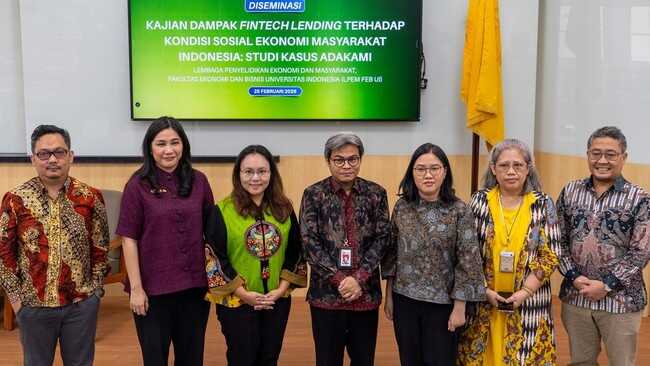
Jakarta — Online lending platform AdaKami has demonstrated its contribution to national economic growth through the distribution of financing to the public. Based on the latest research from the Institute for Economic and Social Research at the Faculty of Economics and Business at the University of Indonesia (LPEM FEB UI), AdaKami is estimated to contribute to Indonesia’s Gross Domestic Product (GDP) in the range of Rp 6.95 trillion to Rp 10.96 trillion through 2024.
This contribution represents the ripple effect from loan distribution. The impact is felt not only by AdaKami borrowers but is also visible through local economic activity via increased economic circulation across various industrial sectors. This ripple effect arises because consumption financing serves as a trigger for demand for goods and services in the productive sector.
During the analysis period, LPEM FEB UI recorded that at least 185 national economic sectors gained added value from economic activity triggered by AdaKami funding. The three sectors with the largest impact are other financial institution services (21.34%), government education services (10.03%), and trade excluding motor vehicles and motorcycles (9.30%), which then spread to other sectors both directly and indirectly.
This contribution is equivalent to the GDP of an island nation such as Tonga, which in 2024 recorded a GDP of US$558 million or approximately Rp 9.38 trillion at current exchange rates. Beyond contributing to GDP, AdaKami’s loan distribution also contributes to creating employment opportunities for 47,000 to 78,000 people spread across 17 industrial sectors. These include wholesale and retail trade (19.84%), education services (18.63%), and agriculture, forestry, and fisheries (15.11%).
Responding to this, Deputy Head of LPEM FEB UI, Mohamad Dian Revindo stated that the distribution of financing drives a ripple effect through increased household consumption, both routine and non-routine, which then stimulates the retail, wholesale, transportation, manufacturing, and primary sectors.
“Thus, support for the real economic sector occurs through strengthening demand for productive goods and services which triggers economic activity and production, at least in the short term,” he said in a written statement on Wednesday (25/2/2026).
Meanwhile, AdaKami’s Chief of Public Affairs, Karissa Sjawaldy said that as an online lending platform, the company is committed to providing inclusive and beneficial financing solutions for the Indonesian public. She also believes that inclusive financial access, managed prudently and responsibly, can bring widespread benefits to society.
“The positive contribution generated through financing activity encourages AdaKami to continue providing sustainable services and enhance user financial literacy. In this way, the funding distributed can help people survive, grow, and adapt amid economic dynamics whilst supporting the strengthening of the national economy,” said Karissa.
Household Resilience and Consumption Stabilisation
Research results from LPEM FEB UI also showed that AdaKami loan distribution serves as a financial buffer that helps households meet needs, particularly in urgent situations, thereby maintaining consumption levels (consumption smoothing).
The survey noted that AdaKami loans are also utilised by users to cope with economic pressure or shocks, such as job termination, serious illness, and family death.
Additionally, 24.51% of AdaKami users stated that without online lending, they would have to use savings or sell assets to meet their needs. From this, there is evidence that online lending platforms such as AdaKami serve as a buffering mechanism capable of helping households avoid survival strategies that could harm long-term financial conditions.
This buffering role is reflected in the stability of consumption patterns and household financial management among users. The group of AdaKami borrowers has an average total monthly expenditure of Rp 4.8 million, which is higher compared to other groups. At the same time, AdaKami users also demonstrated relatively better saving behaviour, with average savings of nearly Rp 700,000, higher compared to other groups.
Overall, these findings indicate that AdaKami funding not only promotes meeting consumption needs but also supports households’ ability to manage finances more stably amid economic dynamics.
Supporting Microenterprises and Individual Businesses
Beyond supporting household needs, AdaKami financing is also utilised as capital for developing microenterprises and individual businesses. Survey results showed that 53.1% of users who utilised loans for business purposes used the financing to increase inventory, whilst 28.1% of respondents noted an increase in business turnover.
Findings from in-depth interviews also showed that AdaKami financing helps business operators increase business scale gradually, in line with increased production capacity and sales activity. The main business sectors utilising the financing include trade (53.1%), accommodation and food services (18.8%), and agriculture (18.8%), which are sectors around community economic activity and play an important role in local economic circulation.
Users’ Financial Literacy Relatively High
The survey also noted that AdaKami users have relatively high financial literacy levels. As many as 89.2% of respondents understood the concept of interest, fees, and loan tenor. Additionally, understanding of financial principles and concepts in general, such as inflation and investment, demonstrated strong financial awareness among the platform’s user base.