
Supercarrier: The Most Formidable Aircraft Carriers in the World
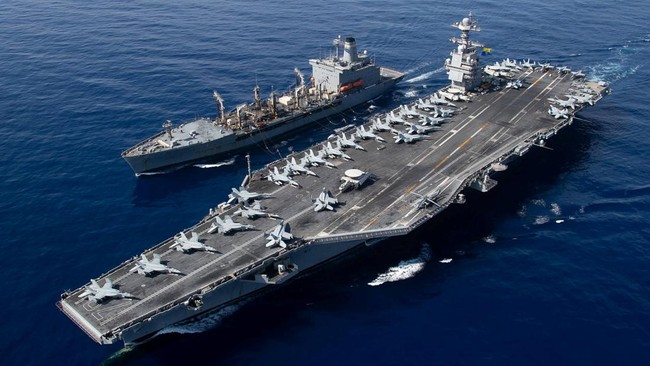
Eight decades after the conclusion of World War II, aircraft carriers remain at the centre of global military architecture.
Aircraft carriers function as mobile air bases that enable a nation to project its military power far beyond its territorial waters. With giant flight decks and fleets of fighter jets on board, aircraft carriers provide air strike capability in the open ocean. This function makes aircraft carriers a strategic asset in modern military operations.
Aircraft carrier technology is advancing rapidly heading into 2026. Fleet modernisation is occurring across various major maritime nations, particularly with the adoption of nuclear propulsion and more efficient aircraft launching systems.
According to historical analysis, modern aircraft carriers have a size approaching 100,000 tonnes and are capable of carrying dozens of fighter aircraft simultaneously. These vessels serve as both an indicator of a nation’s military capacity and a measure of its geopolitical influence on the high seas.
The greatest dominance lies with the United States. Global Fire Power reports that the United States operates 11 active aircraft carriers. That number nearly equals the total aircraft carriers owned by all other nations combined. The fleet comprises Nimitz-class and Gerald R. Ford-class aircraft carriers that use nuclear reactors. This superiority enables the United States Navy to maintain sustained military presence across various maritime regions worldwide.
The Most Modern Aircraft Carrier
The most advanced aircraft carrier currently is the Gerald R. Ford-class aircraft carrier. This vessel is designed as the new generation replacement for the Nimitz-class. According to America’s Navy, it uses two A1B nuclear reactors with far greater electrical capacity than previous generations. Its flight deck is larger, equipped with an Electromagnetic Aircraft Launch System (EMALS) and modern landing systems. The vessel can carry approximately 90 fighter aircraft and helicopters.
This technology has a direct impact on air operations intensity. The Gerald R. Ford-class can generate approximately 160 flight sorties per day. This figure is approximately 25-33% higher than previous-generation aircraft carriers. The stronger electrical system also creates space for integrating future technologies such as directed-energy weapons.
The previous generation, the Nimitz-class aircraft carrier, remains the backbone of the United States fleet. This aircraft carrier has a length of approximately 333 metres with a displacement of up to 103,000 tonnes. Two A4W nuclear reactors power four propeller shafts that enable the vessel to travel at more than 30 knots. According to historical records, this vessel can operate for up to 20 years without nuclear fuel refuelling and can carry 75-90 aircraft with more than 5,500 crew members.
Expansion in Asia and Europe
The race for aircraft carrier technology is also occurring in Asia. China is accelerating the modernisation of its navy through the Fujian aircraft carrier. This vessel is among the largest aircraft carriers in the world with steam turbine power of approximately 280,000 horsepower. The Fujian can carry approximately 60 aircraft and uses an electromagnetic launch system. The vessel symbolises the significant increase in the capability of the Navy of the People’s Liberation Army in recent years.
In Europe, the United Kingdom operates Queen Elizabeth-class aircraft carriers that form the centrepiece of the modern Royal Navy fleet. This vessel uses conventional gas turbines with power of approximately 100,000 horsepower. Its operational system is designed for Short Take-Off and Vertical Landing (STOVL) fighter aircraft such as the F-35B Lightning II. Each vessel can carry up to 36 fighter jets.
Meanwhile, operational flexibility in amphibious operations is provided by the America-class amphibious assault ships operated by the United States. These vessels are actually designed for amphibious landing operations. However, the composition of their air wings gives them operational capability approaching that of light aircraft carriers. Their air group includes helicopters, MV-22 Osprey tilt-rotor aircraft, and F-35B fighter jets.
Ownership of aircraft carriers in the world is extremely limited. According to Global Fire Power, only approximately eight nations possess active aircraft carriers. Besides the United States and China, other operators include the United Kingdom, Italy, India, France, Russia, and Spain. The cost of building and operating an aircraft carrier reaches tens of billions of dollars, requiring thousands of crew and supporting fleet systems.
Indonesia is not part of this group. Indonesia’s maritime defence strategy emphasises fast attack craft, submarines, and landing craft such as KRI Makassar and KRI Banjarmasin. The operational requirements of the Indonesian Navy are more related to patrol of the archipelago and territorial defence.
In the structure of modern military forces, aircraft carriers continue to play the role of centre of naval power. These vessels carry air wings, multi-layered defence systems, and command capability in the middle of the ocean. In the era of great power competition, the presence of aircraft carriers has become a direct measure of a nation’s military capacity and its influence on the global stage.