
Sulphuric Acid Case: Ministry of Human Rights Calls for Clarity on Court Jurisdiction
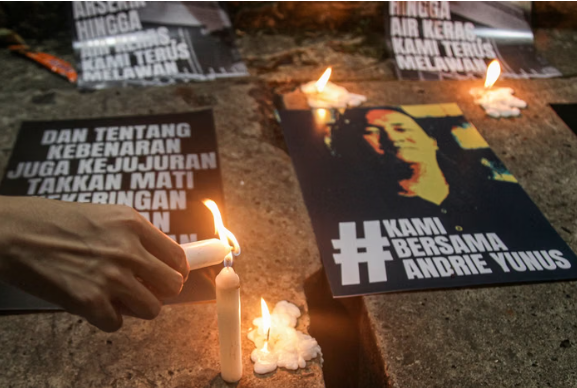
The Ministry of Human Rights (Kemen HAM) has highlighted the importance of implementing a connectivity mechanism in handling the sulphuric acid attack case against Andrie Yunus, which involves four members of the Detachment Headquarters of the Strategic Intelligence Agency (Denma BAIS) of the Indonesian National Armed Forces (TNI). This mechanism is deemed crucial to prevent overlaps in legal processes between civilian and military law enforcement agencies.
“Potential complications and legal complexities, particularly regarding the absolute competence of which court will examine and decide this case,” stated Munafrizal Manan, Director General of Human Rights Services and Compliance at the Ministry of Human Rights, in his remarks on Thursday (26/3).
Munafrizal said the case also has strong human rights dimensions and has attracted wide attention both nationally and internationally.
“This case clearly has human rights dimensions, so it must be handled seriously, taking into account human rights principles,” he said.
He reminded that national criminal law, as affirmed in Law Number 1 of 2023 on the Criminal Code, aims to uphold human rights in every law enforcement process.
According to him, handling this case has the potential to create legal complications that could impact the quality of law enforcement and human rights protection. Therefore, he believes quick coordination and synchronisation between the TNI and the National Police (Polri) is needed.
“Do not let public perception arise that there is dualism and competition between the TNI and Polri in handling this case,” he revealed.
Additionally, he explained that the current situation shows differences in roles between law enforcement agencies. The police have examined witnesses and obtained evidence, while the TNI Military Police Centre (Puspom) has named suspects and detained the alleged perpetrators.
“It would be a legal anomaly if one agency has witnesses and evidence but no suspects, while another agency has suspects but minimal witnesses and evidence,” he said.
Furthermore, he emphasised the importance of clarity regarding the court jurisdiction that will handle this case, whether through the general court or the military court.
Several parties, including the victim’s legal counsel, members of the House of Representatives (DPR), legal experts, and civil society, are reportedly pushing for the case to be tried in the general court.
“So that this case can be thoroughly investigated, not only the field perpetrators but also the possibility of intellectual masterminds,” he said.
Munafrizal also highlighted the importance of applying the connectivity mechanism as regulated in the Criminal Procedure Code (KUHAP) to handle cases involving military and civilian elements.
“The TNI and Polri need to quickly state their position regarding the connectivity case provisions so that there are no two separate law enforcement processes running for the same case,” he explained.
He added that if there are differences in views regarding court authority, the resolution can be pursued through the mechanism for disputes over adjudicative authority at the Supreme Court.
“The Supreme Court has the authority to examine and decide at the first and final level regarding inter-court jurisdictional disputes,” he concluded.