
Successful Maize Harvest in Donggala, NTB Prepares Regional Reserves
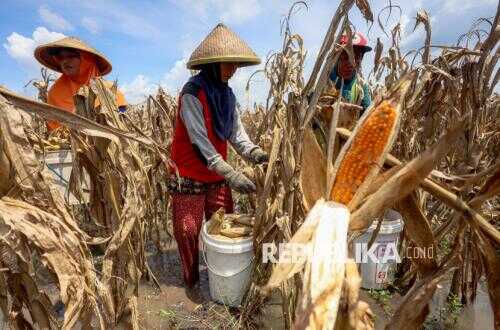
REPUBLIKA.CO.ID, JAKARTA — The Donggala Regency Government, Central Sulawesi, has once again demonstrated its strong commitment to national food self-sufficiency through a maize harvest in Batusuya Go’o village, Sindue Tombusabora sub-district. The total production reached 24 tons from an area of 3.9 hectares planted in a coconut plantation, an innovation by local farmers.
“This is clear evidence of the success of farmers in cultivating land potential,” said the Regent of Donggala, Vera Elena Laruni, when met by the media in Banawa, Thursday. This harvest is in line with President Prabowo Subianto’s Asta Cita in strengthening national food security.
The Regent emphasised that food self-sufficiency is not just about production figures, but also a tool to reduce poverty and prevent social problems. She encouraged the formation of village maize reserves based on mutual cooperation so that each village has its own reserves to face emergency situations.
The local government provides full support, starting from the provision of seeds to technical assistance for farmer groups. Vera hopes that this harvest will be a momentum towards Donggala becoming a food-independent and competitive region.
On the other hand, West Nusa Tenggara (NTB) province is also strengthening food security with plans to establish regional maize reserves as a complement to rice reserves. The Acting Head of the NTB Agriculture and Food Security Office, Eva Dewiyani, explained that this step is anticipatory in facing price fluctuations during the peak harvest season.
“NTB has an area of approximately 173,000 hectares with a production of more than one million tons per year, making it one of the largest maize producers in the country,” said Eva in Mataram, some time ago.
The maize reserve is expected to be an instrument to stabilise prices at the farmer level, which is currently stable at around IDR 6,500 per kg thanks to the government’s floor price, and to expand food reserve options so as not to rely solely on rice. Eva reminded the importance of maintaining environmental balance by avoiding the clearing of forest land for maize cultivation.
Meanwhile, in Mataram City, maize production has actually decreased drastically from 1,141 tons in 2024 to only 36,376 tons in 2025. The Head of the Mataram City Agriculture Office, H Lalu Johari, explained that this decline was triggered by several factors: farmers switching to rice plants due to sufficient water availability, the area of maize land shrinking to 1,485 hectares, and the character of farmers who prefer rice, easy maintenance, stable prices, smooth sales, and low risk.
Although maize production has decreased, rice production has actually increased from 23,078 tons to 24,411 tons (an increase of 1,333 tons or 105.78 percent), thanks to the handling of pests and diseases (Organisme Pengganggu Tumbuhan/OPT) such as stem borers and brown planthoppers by the POPT team during the rainy season.