
Subsidy Burden on Fuel Swells, Economists Warn State Budget Could Lose Buffer
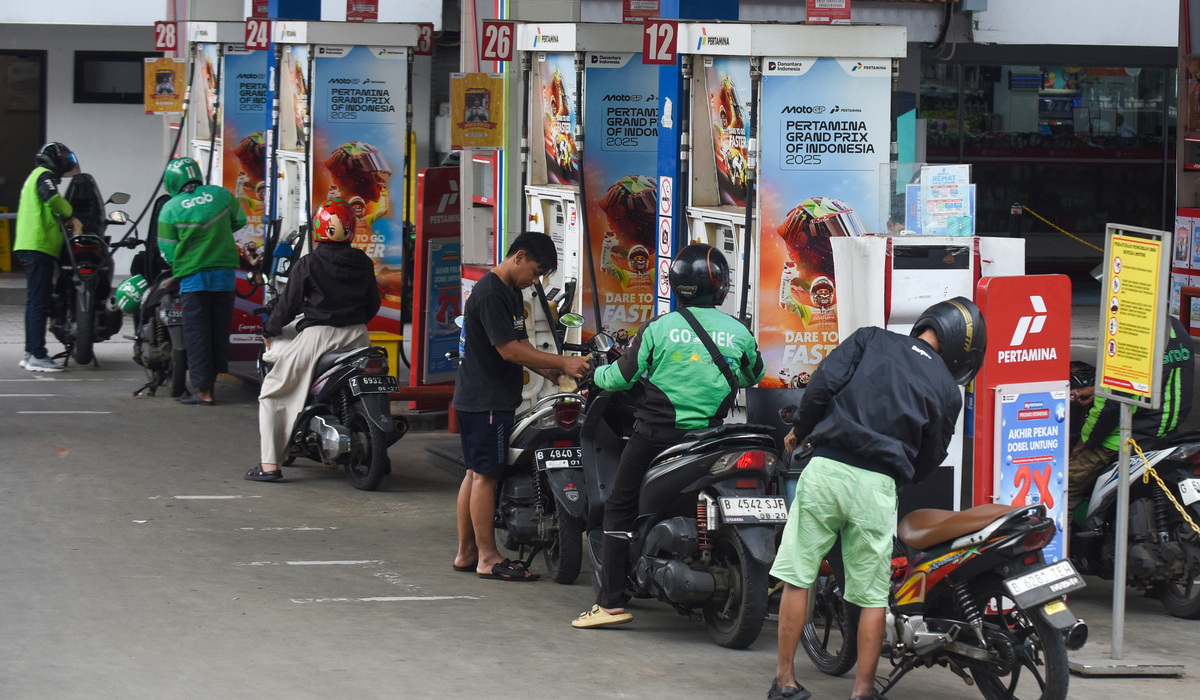
The government’s policy of holding subsidised fuel prices steady is feared to increase the fiscal burden. One measure being prepared by the government is budget efficiency.
Economist from the Center of Reform on Economics (CORE), Yusuf Rendy Manilet, assesses that Indonesia’s fiscal position remains relatively controlled as long as three key assumptions are met. These are global oil prices at a maximum of US$100 per barrel, the exchange rate in the range of Rp16,500–Rp17,000, and budget efficiencies realised in the range of Rp100–Rp200 trillion.
“In that scenario, the state budget still has room to hold subsidised fuel prices steady and, at the same time, without causing the deficit to exceed 3% of GDP,” said Yusuf when contacted on Tuesday (7/4).
However, he continued, the issue becomes far more complex when those assumptions begin to shift. If oil prices rise higher or the rupiah weakens more deeply, while at the same time efficiency policies do not run optimally, pressure on subsidy spending will increase sharply.
At that point, said Yusuf, the state budget loses one of its ‘buffers’ because the subsidy burden swells but is not offset by savings on the other spending side. In such conditions, policy choices become increasingly narrow and none are truly comfortable.
“The government faces a dilemma of continuing to hold fuel prices with the consequence that the deficit could widen above 3%, or making price adjustments that risk suppressing purchasing power and driving inflation. If both are avoided, then the only way is to implement much deeper and bolder efficiencies,” he stated.
This means, said Yusuf, that efficiencies can no longer be cosmetic or only target operational spending, but must begin to touch major programmes, including those previously considered strategic such as MBG, the Red White Village Cooperative, and other programmes with significant budget allocations. “This is indeed not easy politically, but from a fiscal perspective, it becomes a logical consequence to maintain the credibility of the state budget,” he concluded.
As reported, the government has decided not to raise the prices of subsidised fuel, namely Pertalite and diesel, until the end of 2026. At a press conference on Monday (6/4), Purbaya stated that they had tested the budget’s resilience with global oil prices averaging up to US$100 per barrel until the end of the year.
With cuts and savings here and there, he said, the government ensures the state budget deficit can be kept around 2.9%.
“My budget is sufficient. If it gets tight, how? For example, if prices are higher, out of control. As long as the supply is there, we still have a financial cushion of Rp420 trillion, which is now in the form of surplus budget or SAL. If it gets tight, that can still be used,” explained Purbaya.
“But I think we’re still far from that because the chance of oil prices staying above US$100 for a prolonged period is small if we look at the politics in the United States,” he added.
He also asked the public not to worry and speculate that the government could run out of budget.
“However much, we have plenty of money, we’re rich. So our money is sufficient. Every policy given earlier certainly has cost consequences to us and we’ve calculated it, it’s enough,” he concluded. (H-3)
Former Vice President Jusuf Kalla has proposed that the government reduce fuel subsidies through price adjustments.
The government’s certainty not to raise subsidised fuel prices in 2026 sends a strong signal in maintaining national economic stability.
The Minister of Energy and Mineral Resources (ESDM), Bahlil Lahadalia, stated that the government is still discussing adjustments to the prices of general fuel types (JBU) or non-subsidised fuel.
Senior Economist from Paramadina University, Wijayanto Samirin, reminded the government to be more serious in managing finances amid increasing state budget pressures due to the conflict in the Middle East.
Although the informal sector plays a role as an economic buffer, this sector does not provide adequate welfare guarantees for workers.
The use of the Rp420 trillion surplus budget (SAL) as a cushion also needs to be criticised.
Finance Minister Purbaya Yudhi Sadewa emphasised that Indonesia’s economic stability remains maintained despite facing global uncertainties due to geopolitical escalations.