
Strengthening Societal Impact: Universities in West Java Hold FGD on Service-Learning Dissemination and Collaboration
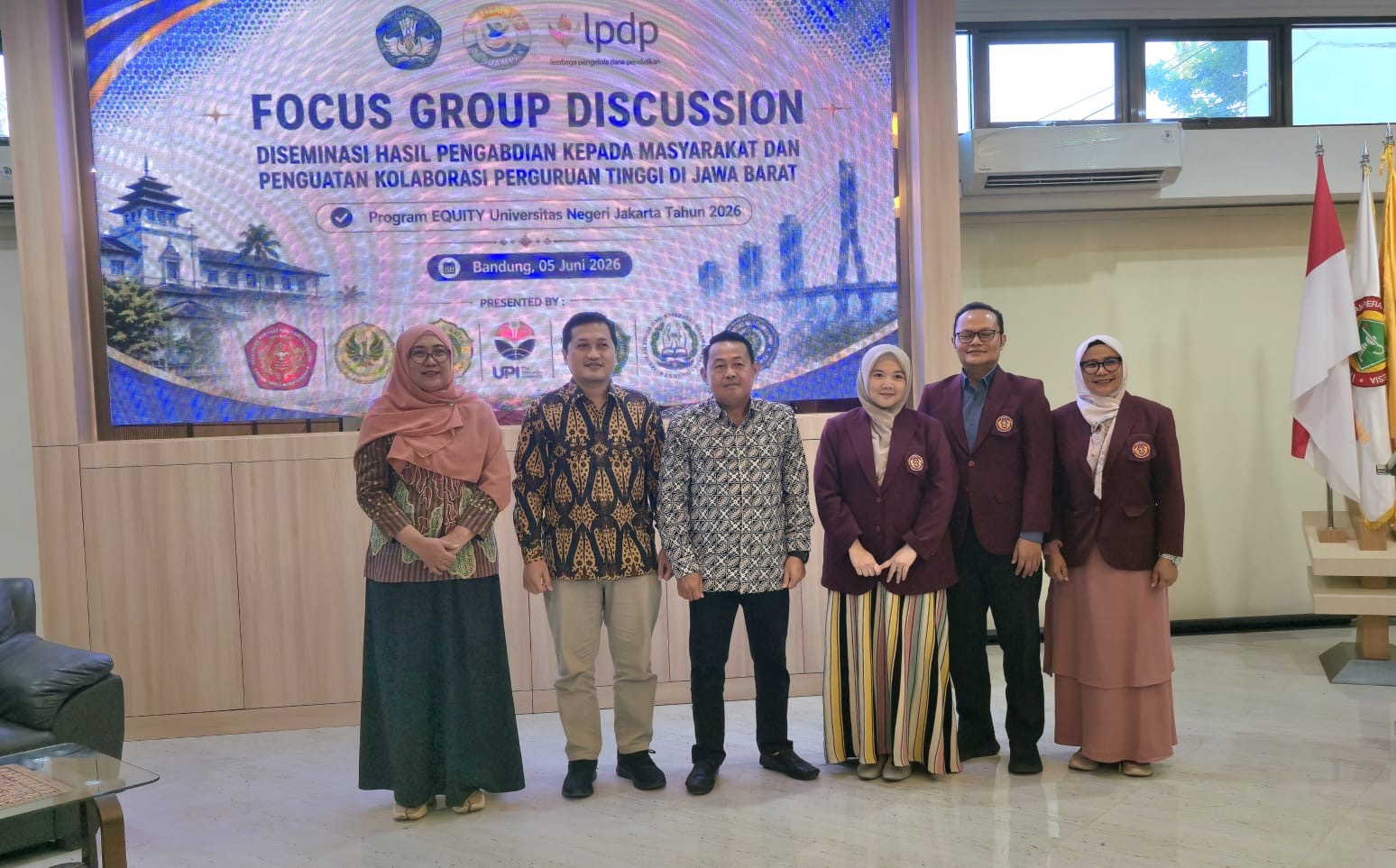
Universitas Negeri Jakarta (UNJ), through the Enhancing Quality Education for International University Impacts and Recognition (EQUITY) Programme, continues to strengthen the role of higher education institutions in providing real solutions for society through innovative and sustainable community service. This commitment was demonstrated through the holding of a “Focus Group Discussion (FUT) on the Dissemination of Community Service Results and the Strengthening of University Collaboration in West Java,” which took place on Friday (5/6) at the STIKEP PPNI West Java Campus Hall, Bandung.
This activity is part of the UNJ EQUITY Programme’s strategy to expand the dissemination of good practices from community service while strengthening collaborative networks between higher education institutions. Through this forum, various innovations, empowerment models, and community service approaches that have proven beneficial to the public were discussed for potential replication and wider development.
The FGD was attended by representatives from various universities in West Java, including Universitas Pendidikan Indonesia (UPI), Universitas Padjadjaran (UNPAD), STIKEP PPNI West Java, Universitas Katolik Parahyangan (UNPAR), Universitas Jenderal Achmad Yani (UNJANI), STIKES Dharma Husada Bandung, and the UNJ team. The presence of these various institutions reflects a collaborative spirit in building a stronger, more inclusive, and impactful community service ecosystem.
The Chairperson of STIKEP PPNI West Java, Linlin Hindayani, expressed her appreciation for UNJ’s initiative in providing a space for dialogue and collaboration between universities. According to her, increasingly complex social challenges require cross-institutional synergy so that the resulting solutions are more comprehensive and sustainable.
Similarly, Wawan Arif Sarwana, Chairperson of the Indonesian Nurse Foundation, emphasised that community service is a tangible form of university contribution to improving the quality of life for the community. He expressed hope that forums such as this could produce collaborative programmes that provide a direct impact on regional development.
The Vice Rector of UNJ for Research, Innovation, and Information Systems, Prof. Fahrurrocalzi, asserted that community service is a strategic instrument in realising the role of universities as agents of social change.
“Through the EQUITY Programme, UNJ is not only oriented towards improving the quality of education and international reputation, but also ensuring that the results of research, innovation, and community service can provide direct benefits to the community. Cross-university collaboration is key to expanding this impact more systematically and sustainably,” he stated.
Meanwhile, the Head of the Institute for Research and Community Service (LPPM) at UNJ, Prof. Iwan Sugihartono, explained that West Java is a region with highly diverse social potential and challenges, making it a strategic space for various community service programmes.
“Various community service themes currently developing, ranging from cultural preservation, SME strengthening, inclusive education, women’s empowerment, to the digital transformation of society, are issues very relevant to the needs of the West Java community. Therefore, synergy between universities needs to be continuously strengthened so that the solutions produced become increasingly comprehensive and widely impactful,” he said.
On the same occasion, the Director of Innovation, Downstreaming, Information Systems, and Ranking at UNJ, Murti Kusuma Wardani, emphasised the importance of downstreaming community service results as part of enhancing institutional reputation and making a real contribution to achieving the Sustainable Development Goals (SDGs).
“The success of community service is not only measured by the number of programmes implemented, but also by the sustainability of the impact, the opportunity for replication, and the ability to build community independence. This forum serves as a strategic platform to bring together ideas, experiences, and broader collaboration opportunities,” she explained.
Through this FGD, participants successfully formulated a mapping of strategic community service themes, drafted recommendations for strengthening collaboration between universities, and expanded academic cooperation networks in the field of community service.
This activity also reaffirms the commitment of the UNJ EQUITY Programme to building a culture of collaboration capable of strengthening the impact of community service, driving social innovation, and contributing to sustainable development in Indonesia.