
Strengthening Economic Cooperation: Indonesia as a Strategic Partner of the US
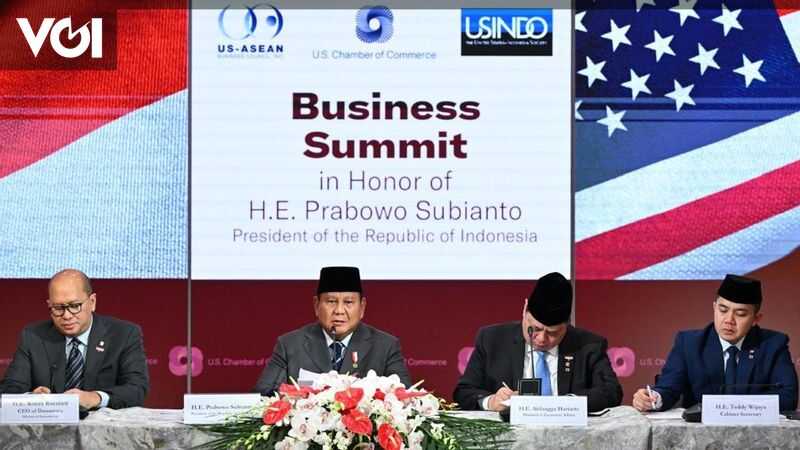
JAKARTA - President Prabowo Subianto attended the US-Indonesia Business Summit 2026 (RI-US Business Forum 2026) as part of his working visit to the United States.
The event was organised by the U.S. Chamber of Commerce (USCC), the US-ASEAN Business Council (USABC), and the U.S.-Indonesia Society (USINDO) in Washington D.C.
On that occasion, President Prabowo was accompanied by Coordinating Minister for the Economy Airlangga Hartarto, Minister of Investment and Industrialisation/BKPM Rosan Roeslani, Minister of Energy and Mineral Resources Bahlil Lahadalia, Cabinet Secretary Teddy Indra Wijaya, and the Ambassador of the Republic of Indonesia to Washington D.C.
Prabowo emphasised that his visit to the United States was aimed at concluding an important trade agreement, namely the Agreement on Reciprocal Trade (ART), which has strategic implications for businesses, investors, and supply chains in the Pacific region.
“Indonesia and the US choose deeper economic cooperation, stronger market access, and greater certainty for businesses,” Prabowo said in a statement, Thursday, 19 February.
President Prabowo’s visit to the United States is in the framework of The Inaugural Meeting of the Board of Peace (BOP) and at the same time the completion and signing of the Agreement on Reciprocal Trade (ART).
“As President, my responsibility is very clear. I have to convince stability, predictability, and execution. Without these, confidence weakens, and with them, investment follows. Indonesia’s economic fundamentals are strong,” he said.
Meanwhile, Airlangga said that the United States is Indonesia’s main strategic partner in the fields of trade and investment.
He added that this forum is an important momentum to deepen the collaboration of the two countries’ private sectors, especially in the fields of digital innovation, artificial intelligence (AI), semiconductors, critical minerals, supply chain resilience, and energy transition.
Furthermore, Airlangga emphasised that Indonesia and the United States had completed negotiations on the Agreement on Reciprocal Trade (ART) and are currently preparing for the signing and implementation phase.
According to him, the agreement reflects the commitment of both countries to strengthen market access, simplify trade barriers, increase business certainty, and open up wider and sustainable investment opportunities.
“The completion of the ART is an important milestone achieved through intensive and constructive negotiations between the two countries. This agreement shows Indonesia’s seriousness in creating an increasingly open, transparent, and investment-friendly business environment,” said Airlangga.
The Business Summit also became a strategic dialogue forum between the Indonesian Government and the leaders of leading American companies, as well as a momentum for the signing of a number of memorandums of understanding (MoU) with a total potential value of around US$38.4 billion.
The commitment includes the agriculture sector of US$2.5 billion and the industrial sector of US$35.9 billion, including cooperation in the field of semiconductors and strategic industrial materials.
Airlangga conveyed that the presence of President Prabowo and the enthusiasm of the US business world (USCC, USABC and USINDO) at this forum confirmed Indonesia’s position as a credible and strategic economic partner for the United States, especially in the business world.
In the future, he added, the synergy between the governments and the private sectors of the two countries is expected to expand more qualified investments, deepen integration in the global supply chain, and create productive and highly competitive jobs.
“This increasingly close collaboration is an important foundation in maintaining economic stability and accelerating structural transformation towards inclusive and sustainable growth,” he said.