
Strengthen Eco-Theology-Based Climate Action, Energy Waqf and Energy Sadaqah Officially Collaborate
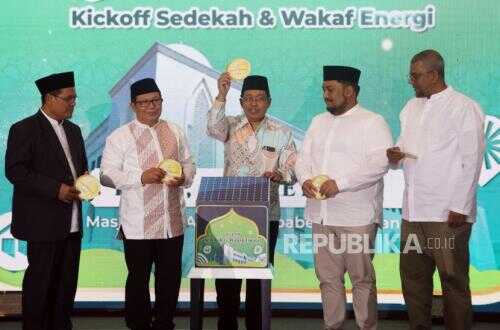
To spur public involvement in Indonesia’s target of 100 GW of renewable energy, an officially integrated Islamic philanthropy programme was launched at a Gala Iftar held at Masjid Raya Al Azhar Jababeka Cikarang. Through the ‘Nyala Ramadan’ event, the Energy Waqf programme of Yayasan Pesantren Islam Al Azhar and Energy Sadaqah from Muslims for Shared Action on Climate Impact (MOSAIC) officially synergised to accelerate the national energy transition through an ‘Eco-Theology’ approach, a concept that blends religious teachings with the responsibility to steward the natural world.
This launch became a symbol of a renewed religious community’s commitment to the environment. In the face of the global climate crisis, mosques are urged to play a strategic role not only as places of worship but as hubs of education, inspiration and practical action in using clean energy.
Minister of Religious Affairs of the Republic of Indonesia, Prof Nasaruddin Umar, in a keynote address welcomed the initiative, emphasising that it is important to strengthen public initiatives and houses of worship in realising Indonesia’s target of 100 gigawatts of new renewable energy.
‘Waqf energy reminds us of the Prophet Muhammad’s companion Uthman ibn Affan, who endowed wells and palm groves; he did so for the sovereignty of water. We, with energy waqf, strive for energy sovereignty. This programme turns sunlight into clean energy to power our mosques and social facilities. It is a productive asset whose proceeds support education and social services in a sustainable manner,’ he said.
In line with this, the Director for Zakat and Waqf Empowerment at the Ministry of Religious Affairs, Prof Waryono Abdul Ghafur, highlighted the importance of collaboration among many parties to promote the programme. ‘Energy sadaqah must be marketed to muzakkin, wakifs, and donors. Today, you can donate energy, not only in the form of buildings. The key is to collaborate, and mosques become a symbol that the power of the community lies in synergy,’ he explained.
The Energy Sadaqah programme initiated by MOSAIC has previously mobilised more than 21,000 donors to fund solarisation at six mosques across Indonesia, delivering 23,525 WP of solar power from installed rooftop panels. The programme has also trained dozens of local mosque community members to manage rooftop solar technology independently.
MOSAIC Programme Director Aldy Permana expressed optimism about the synergy with YIA Al Azhar. ‘What we have started through Energy Sadaqah demonstrates the high level of public concern about climate issues. By integrating it with Energy Waqf, we are working to create a green financing model rooted in the community that is far larger, more transparent, and capable of replicating solarisation more massively across Indonesia,’ he said.
From the perspective of optimising community assets, the Management of the Al Azhar Islamic Boarding School Foundation (YPI Al Azhar) explained that using solar energy is highly recommended in Islam. ‘In Islam, it is encouraged to harness energy for the benefit of humanity; this is the Quran’s challenge to us all. Therefore we need to jointly utilise solar energy to solarise mosques to conserve electricity,’ he added.
At this event, the Al Azhar Islamic Boarding School Foundation also articulated its commitment to broadening the initiative and ensuring that donors’ funds are transparently managed and compliant with Sharia principles, ensuring that the programme’s impact is measurable and sustainable, and expanding this model to more mosques and educational institutions under the foundation.
The event, attended by ministry representatives, zakat and waqf institutions, the private sector, academics, and media, also sought to secure pledges from attendees to fund solarisation projects for mosques in various regions. Nurul Iman Mosque in Aceh Tamiang, affected by floods at the end of last year, will be the first pilot site to realise the synergy of the two programmes.
Taking advantage of the Ramadan spirit of sharing, the public is invited to broaden the benefits of this initiative by contributing to the project via www.wakafenergi.id. The joint initiative is hoped to trigger a larger umat-based energy transition wave in the years ahead.