
Street Gold Buying Stall in Senen Sidewalk: Open 24 Hours, Sells Without Hassle
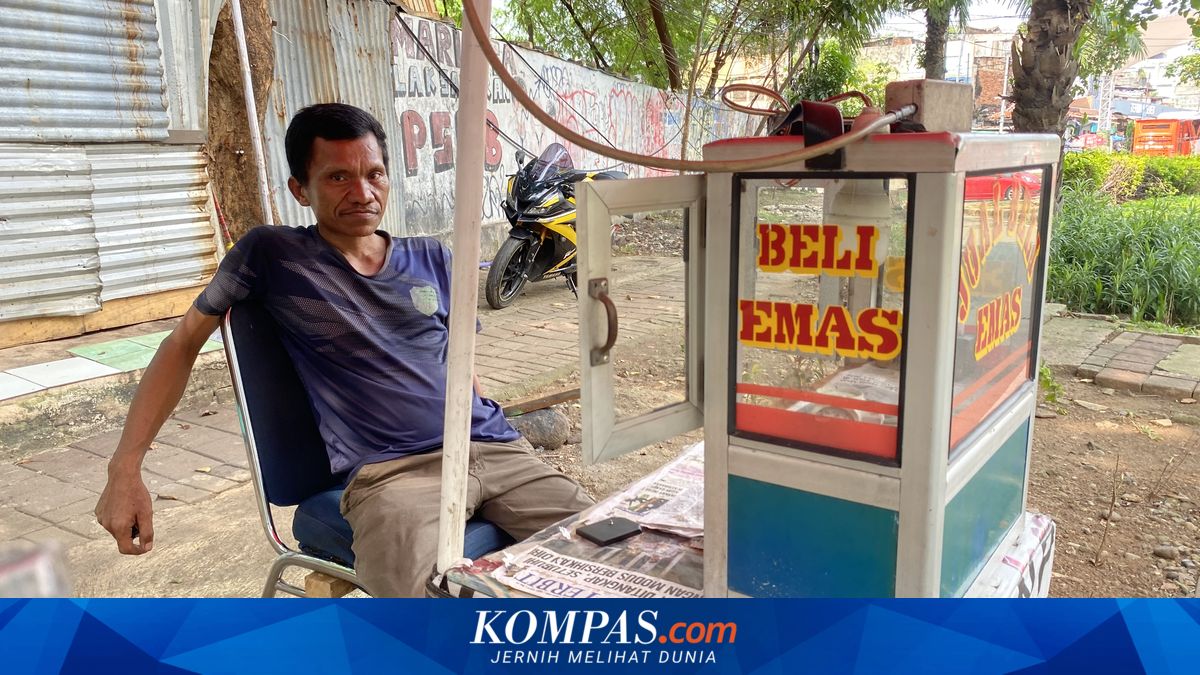
JAKARTA - A gold buying and selling stall stands simply on the edge of Senen Street and Senen Street III in Central Jakarta, right on the tree-shaded pavement.
There is no large sign or luxurious display case like in typical jewellery shops.
Instead, what is visible is a small glass box resembling a mini aquarium, framed in aluminium, placed on a stall table covered with old newspapers.
On the side of the glass box is a striking yellow-red inscription reading “BUY GOLD”, a clear indicator that the stall accepts direct gold transactions on the spot.
The bottom of the box is painted bluish-green, while the top is open with a small glass door that can be opened and closed for transaction activities.
On the table, the atmosphere is filled with small items typical of street gold traders: transparent clip plastics containing metal granules, a black testing stone used for rubbing gold, and small bottles of testing liquid.
The bottles are small, clear, with pointed tips like pipettes, allowing the liquid to be dripped drop by drop onto the rub mark on the testing stone.
One of the most eye-catching items is a clip plastic containing silver granules, shaped like small rough cylinders, not yet processed into jewellery.
The granules fill the bottom of the plastic, creating a characteristic metallic clinking sound when shaken.
Behind this simple appearance, gold transactions take place almost non-stop.
This stall, along with several similar ones lined up around the Senen Market area, serves as a shortcut for residents wanting to liquidate jewellery without many procedures.
Amid the popularity of digital gold investments and modern jewellery stores, roadside gold stalls remain resilient. In fact, some of them operate 24 hours.
“If at a shop, they usually won’t buy if there’s no paperwork. But here, even without papers, we’ll buy it,” said Limbong (45), a gold trader who has been minding the stall for 10 years, when met by Kompas.com on Tuesday (14/4/2026).
Limbong is not the main owner of the business. He describes himself as just the stall keeper.
However, his decade of experience is enough to read the changes in the landscape of informal gold trading in Senen.
He recounts that the street gold stalls have existed for decades. In the past, there could be up to 30 traders in a row.
They lined up long until nearing the hospital. Now, the number has shrunk drastically.
“In the past, this place was full, up to 30 people lining up towards the hospital. Now, only about nine people left in this Senen area,” said Limbong.
According to Limbong, the uniform form of the stalls is indeed a characteristic of Senen gold traders from way back.
“Yes, it’s been like this since the old days. The difference is, back then they used candles, now they use lights at night,” he said.
The transaction process at the roadside gold stall does not require a special room. Buyers and sellers stand or sit facing each other on the pavement, flanked by the sounds of vehicles and shouts from other traders.
When someone comes with jewellery, Limbong immediately asks for the item to be tested. He rubs a small part of the gold on the black testing stone. After that, acid liquid is dripped on.
“We test first, check the purity level. Rubbed on the stone, using testing water. There’s water to test if it’s gold or not, and water to test the gold purity in two types, Acid 1 and Acid 2,” said Limbong.
The liquid is known as nitric acid. Limbong explains that the colour reaction from the liquid helps the trader assess whether the item is real gold or just plated.
Once the purity is determined—18 carat, 22 carat, or 24 carat—the transaction moves to the bargaining stage for the price.
On his stall table, a small digital scale is an equally important tool. Without it, the price cannot be determined.
“In one transaction, I can get over Rp 200,000,” he said.
However, Limbong emphasises that the profit is not always stable. Some days are busy, others are quiet.