
Stockpiled Goods in Factories, Indonesian Manufacturing Signals Danger
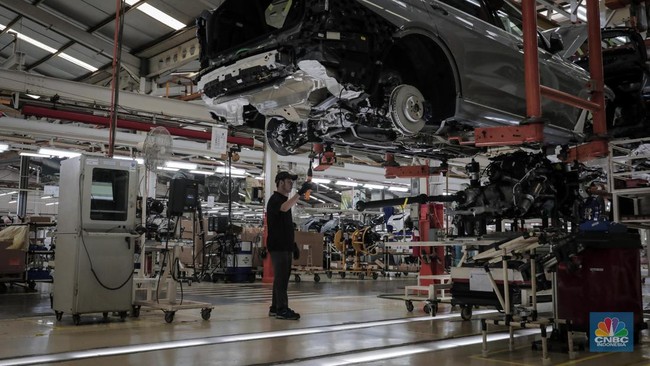
Indonesia’s manufacturing industry performance in March 2026 still showed expansion. However, its growth rate began to lose momentum following the surge in activity at the start of the year.
The Industrial Confidence Index (IKI) for March 2026 was recorded at 51.86. This figure remains above the 50 level, indicating the expansion phase, although it slowed compared to the previous month.
“The performance of the non-oil and gas processing industry in March 2026 is 51.86. Higher than 50, meaning we can state that the manufacturing industry in March 2026 is still expanding,” said Spokesperson for the Ministry of Industry Febri Hendri Antoni Arief in the IKI Release at the Ministry of Industry office on Tuesday (31/3/2026).
The decline was quite noticeable when compared to February 2026, which reached 54.02. Even on an annual basis, this figure is also lower than March last year, which was at 52.98.
“The value of 51.86 means a slowdown of 2.16 points compared to the IKI for February 2026 of 54.02. In addition, the IKI also slowed by 1.12 points compared to the IKI for March last year of 52.98,” he explained.
By sector, the majority of industries still held in the expansion zone. Of the 23 subsectors analysed, 16 subsectors recorded growth.
“Of the 23 processing industry subsectors analysed, there are 16 subsectors experiencing expansion and 7 subsectors experiencing contraction. These expanding subsectors contribute 78.3% to GDP,” Febri revealed.
Nevertheless, the number of subsectors experiencing contraction increased compared to the previous month. This serves as a signal that pressure is beginning to spread across various industry lines.
Industries with the highest performance include printing and automotive, still driven by supply chain needs and downstream sector demand.
“The highest IKI subsectors are the printing and recording media reproduction industry as well as the motor vehicle, trailer, and semi-trailer industry,” he said.
Meanwhile, several subsectors such as beverages, chemicals, to electronics began to experience contraction. This condition also affects the overall production dynamics.
From the IKI component side, the slowdown is evident in new orders and production. Conversely, inventories actually increased.
“The IKI value for the new orders variable experienced a slowdown of 3.16 points or reached 52.20. Next, the production variable also experienced a slowdown of 2.80 points or reached 51.55. Conversely, the IKI variable for product inventory experienced an increase of 1.22 points or reached 51.47,” he explained.
This condition reflects the accumulation of goods in warehouses due to suboptimal distribution, especially after the long holiday period. Export- and domestic-oriented industrial activities still held in the expansion zone, though both experienced slowdowns.
“The IKI for export-oriented industrial companies in March 2026 reached 52.73; still expanding although there is a slowdown. The same applies to domestic market-oriented industrial companies, with an IKI value of 50.44; still expanding although also experiencing a slowdown,” he said.
On the other hand, business players’ perceptions of business conditions are also starting to change. The portion of industries feeling their businesses are declining has increased, while those feeling improved have decreased.
“The proportion of industries stating that their business conditions improved in March 2026 is 30.2%, down from the previous month. Meanwhile, those stating a decline rose to 26.3%,” Febri said.