
Stock plunge sparks trading halt in South Korea's key indexes
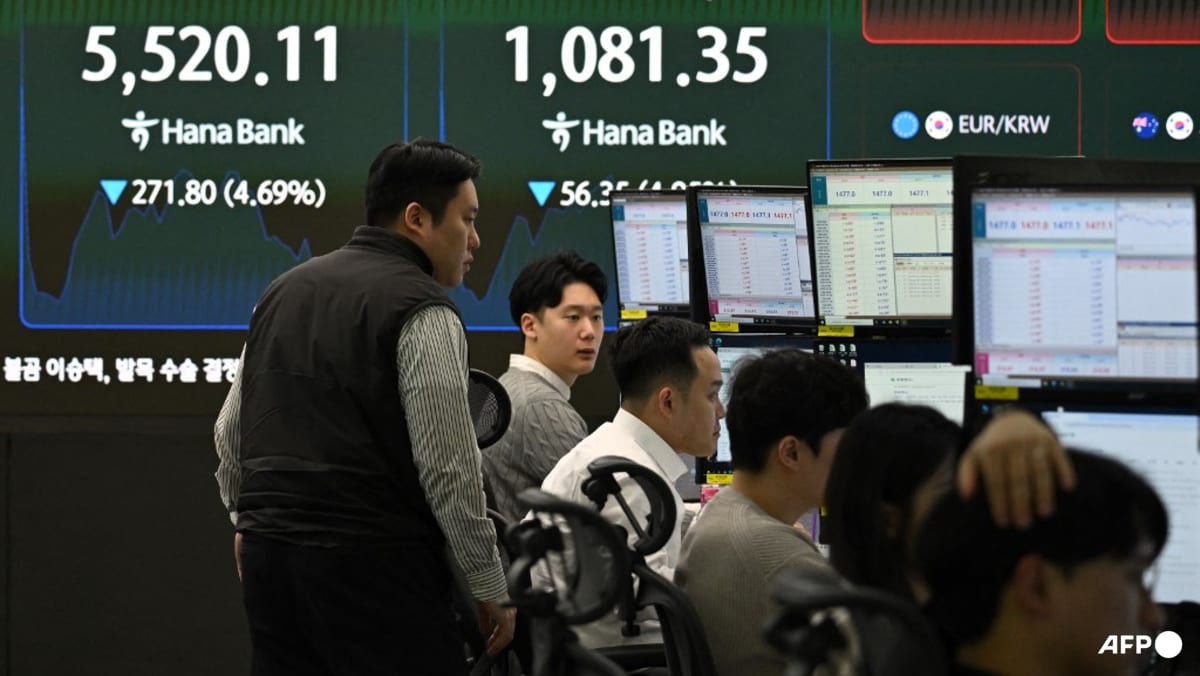
Stock plunge sparks trading halt in South Korea’s key indexes
The Kospi plunged 8 per cent on Wednesday (Mar 4), extending a steep selloff from the previous day as the escalating war in the Middle East rattled investor sentiment.
SEOUL: South Korea’s stock exchange halted trading on Wednesday (Mar 4) as the nation’s two major indexes plunged on uncertainty sparked by turmoil in the Middle East.
The Korean Stock Exchange called a temporary trading halt after the Kospi and Kosdaq each plunged more than 8 per cent in Seoul morning trade.
The index tumbled 7.2 per cent on Tuesday, its worst session since August 2024, as investors bailed out of a market that had soared on a world-beating, artificial intelligence-driven rally.
South Korea is the world’s fourth-largest oil importer. It relies almost totally on imports for its energy, with around 70 per cent of its oil imports coming from the Middle East.
Earlier, the won weakened past a key psychological barrier of 1,500 per dollar for the first time in 17 years.
“We will closely watch if won exchange rates and bond yields deviate excessively from domestic fundamentals even with external factors in consideration,” the Bank of Korea said in a statement soon after the market opened on Wednesday, as the central bank vowed to respond to herd-like behaviour.
Japan’s Nikkei share average slipped on Wednesday to its lowest level in a month as investors sold risk assets amid an intensifying Middle East conflict.
The Nikkei fell 3.5 per cent as of 2.15am GMT, marking its lowest point since Feb 6, and is on track for a third consecutive session of losses, if current momentum persists.
The broader Topix lost 3.7 per cent
“Investors sold down risk assets, and in particular, the Nikkei as well as the Kospi, which outperform other major indexes, have become a target of the heavier selloff as they try to book profits,” said Kazuaki Shimada, chief strategist at IwaiCosmo Securities.
As the joint strikes on the Islamic republic moved into a fifth day, observers warned that the continued choking of crude supplies from the Middle East would continue to push prices higher and deal a blow to hopes for any more monetary easing.
US President Donald Trump pledged that if needed, the navy would escort oil tankers through the Strait of Hormuz - through which about a fifth of global oil supplies flow - and ordered Washington to provide insurance for shipping.
That provided some relief to traders and pared a rally in prices Tuesday.
However, Iranian strikes on several neighbours threatened to broaden the conflict, while uncertainty about how long the war would go on and news that some oil fields in the region had been closed continued to put upward pressure on the commodity.
Both main oil contracts rose around one percent Wednesday.
West Texas Intermediate has soared 12 percent to more than $75 since last Friday, before the attacks began, while Brent is up more than 13 percent to sit above $82.
With some warning that they could top $100 a barrel, equity markets are taking a pounding.
“Asian equities are now staring at a third consecutive day of losses and the reason is not mysterious,” wrote Stephen Innes at SPI Asset Management.
“When crude edges higher, the invoice lands hardest in Asia, where imported energy is not just a line item but a structural dependency.
“Export-driven economies suddenly find themselves recalculating margins with a more expensive barrel sitting quietly in the background of every factory floor and shipping lane.”