
Stock Exchange Chief Responds to IHSG Plunge of 5.2% This Morning
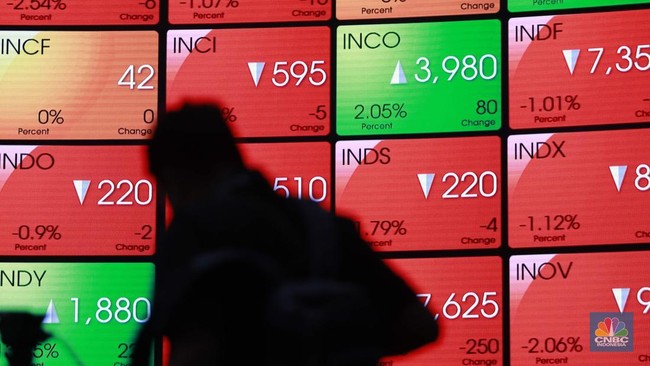
Jakarta, CNBC Indonesia — The Indonesian Stock Exchange (BEI) has responded to the significant volatility in the Composite Index (IHSG) that has occurred since market opening today, Monday, 9 March 2026.
The IHSG collapsed this morning, touching a low of minus 5.2% at the level of 7,156. A total of 449 shares fell, 57 rose, and 158 remained unchanged, with transaction value reaching Rp 1.5 trillion.
Acting Chief Executive of BEI Jeffrey Hendrik stated that share price movements in Indonesia’s capital market are significantly influenced by external factors.
“Currently we are facing a condition of very high uncertainty due to external factors. As we have previously stated, investors should remain rational, pay attention to fundamental factors and adjust their investment strategies according to each investor’s risk tolerance,” Jeffrey said when contacted by CNBC Indonesia.
Regarding anticipatory steps, BEI emphasised that it has prepared infrastructure and systems that facilitate investors to continue trading normally amid today’s market turbulence.
“The infrastructure systems and trading regulations at BEI have been prepared to face market volatility such as occurred last year in April 2025 when America imposed tariff policies,” Jeffrey explained.
In recent weeks, the IHSG has dropped nearly 8% in just one week, marking the worst decline exceeding the MSCI Crash of late January. There are three key reasons driving the Indonesian stock market’s downturn.
In recent times, the IHSG has been influenced not only by domestic factors but also by external pressures and changes in global investor sentiment towards Indonesia as an investment destination.
Escalating geopolitical tensions, particularly in the Middle East region, have prompted global investors to adopt a more defensive stance. In conditions of uncertainty such as this, financial markets typically experience a shift in sentiment towards risk-off — a tendency for investors to reduce exposure to assets deemed riskier.
Developing countries, including Indonesia, are often among the most impacted because flows of foreign capital that previously entered can quickly reverse direction.
Secondly, there is growing concern regarding Indonesia’s position in global stock indices. Investor attention is also focused on the possibility of changes in Indonesia’s classification within global indices compiled by Morgan Stanley Capital Index (MSCI).
Currently, Indonesia’s weighting in the MSCI Emerging Markets Index continues to experience a downward trend and has already approached 1%. This decline in weighting reflects the increasingly smaller proportion of Indonesia’s stock market in global portfolios that track this index.