
State Finance Bill Drafted Using Omnibus Law Scheme — What Will Change?
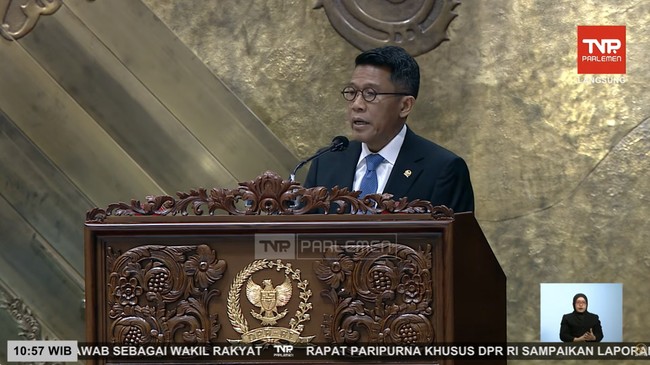
Jakarta, CNBC Indonesia — Commission XI of the DPR RI has begun deliberating the Draft Law (RUU) amending the State Finance Law using an omnibus law approach. The scheme was chosen to align various rules affected by the birth of several new regulations, including the revision of the State-Owned Enterprise (SOE) Law.
The Chairman of Commission XI of the DPR RI, Mukhamad Misbakhun, said deliberation of the bill is still at the stage of gathering input from academics and experts in economics and law.
“This meeting concerns the State Finance Amendment Bill using the omnibus law system, in which we are listening to input as part of meaningful participation, to be considered in the substance of the bill at the working committee meeting,” Misbakhun said when opening the Public Hearing (RDPU) of the State Finance Bill Working Committee at the Parliamentary Complex, Senayan, Jakarta, on Monday (14/9/2026).
At the hearing, Commission XI invited several experts: Dewi Kania Sugiharti, a law lecturer at Padjadjaran University; Tauhid Ahmad, a senior economist at INDEF; Candra Fajri Ananda, a professor at the Faculty of Economics and Business at Brawijaya University; and Dian Puji Nugraha Simatupang, a lecturer in State Administrative Law at the University of Indonesia.
Misbakhun explained that the revision of the State Finance Law is necessary to adjust to various changes that emerged following the issuance of Law Number 1 of 2025 and Law Number 16 of 2025, which revised the rules on SOEs.
The State Finance Bill is one of the bills included in Commission XI’s Priority National Legislation Programme (Prolegnas) for 2026, using the omnibus law method.
For context, the use of the omnibus law method follows the enactment of Law Number 1 of 2025 on State-Owned Enterprises and Law Number 16 of 2025 on the Fourth Amendment to Law Number 19 of 2003 on State-Owned Enterprises, which brought fundamental changes to SOE governance.
One of the most scrutinised aspects of the bill is the transfer of the Finance Minister’s role as state shareholder in SOEs to the Investment Management Agency (BPI) Danantara.
“The SOE Law has removed the Finance Minister as the shareholder of SOEs, with that role now taken over by BPI Danantara,” Misbakhun said some time ago (10/2/2026).
This change, he continued, also affects the mechanism for managing SOE dividends. Previously, SOE dividends were recorded as non-tax state revenues (PNBP), but now they are reinvested by BPI Danantara to strengthen strategic sectors and drive national economic growth.
“So there are several things there that we need to rearrange,” said Misbakhun.
Furthermore, he said, the change in the SOE management structure has direct implications for the State Budget (APBN), particularly regarding the Finance Minister’s function as General Treasurer of the State.
Therefore, on behalf of Commission XI of the DPR RI, he sees the need for a comprehensive overhaul of the legal framework for state finances, covering the State Finance Law, the State Treasury Law, the State Wealth Law, and other laws in the financial sector that are affected.
In the discussion on meaningful participation, one issue that drew attention was the optimisation of Non-Tax State Revenues (PNBP).
Senior INDEF economist Tauhid Ahmad assessed that Indonesia’s PNBP potential remains underexploited. According to him, there are various problems, ranging from diverse tariff structures, services that have not improved, to the management of PNBP receivables.
“There are many issues currently being faced, including related ministries and agencies that still rely on manual services that are often slow, tariffs not accompanied by improvements in quality, especially at PNBP-implementing institutions, and issues relating to PNBP receivables,” said Tauhid.
He also highlighted the still limited regulation governing PNBP from the new and renewable energy (EBT) sector. At present, he said, PNBP schemes are largely applied only to geothermal energy, while other sources such as solar, wind, and bioenergy lack an adequate regulatory basis.
“For example, PNBP on renewable energy is still related to geothermal. Solar, wind, and bioenergy have not yet been accommodated because the government regulations do not exist,” he said.
Therefore, Tauhid proposed periodic evaluations of PNBP tariffs, stronger data integration, and the imposition of windfall profit levies on the natural resources (SDA) sector when commodity prices soar.
“Tariff optimisation is also needed, including the imposition of windfall profit on natural resources,” he said.