
Soybean Importers, Don't Be Naughty! Caught Doing This – Permit Revoked
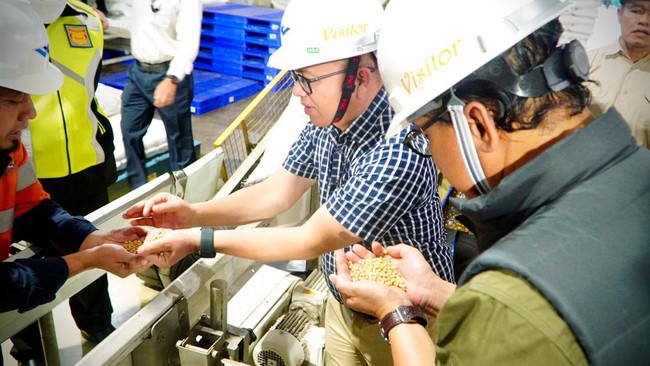
The government, through the National Food Agency (Bapanas), claims that soybean availability in the country remains sufficient for national needs. This is particularly for the production of tofu and tempeh, which contribute around 90% to national requirements.
On the other hand, the government is reminding importers to comply with regulations regarding prices. Sanctions await if violations are detected.
According to Bapanas, national soybean availability is projected to range from 322,500 tonnes until the end of April. This figure is said to be adequate to support monthly soybean needs of around 220,000 to 230,000 tonnes. This calculation is based on the Soybean Food Balance Projection for 2025, which will be updated monthly.
The Acting Secretary of Bapanas, Sarwo Edhy, stated that soybean supplies, both from imports and domestic production, are projected to remain at a safe level until the end of April.
“Currently until the end of April, our soybean stock is still 322,000 tonnes. This means it is still sufficient. We also communicate almost daily with the Indonesian Tofu and Tempeh Producers Cooperative Union (Gakoptindo). Soybean prices at the artisan level are still normal,” said Sarwo in his statement on Friday (17/4/2026).
Sarwo also urged soybean importers to adhere to the price ceiling set by the government. The Reference Selling Price (HAP) for soybeans at the importer level is a maximum of Rp11,500 per kilogram (kg), and at the consumer or tofu and tempeh artisan level, it must not exceed Rp12,000 per kg.
From Bapanas’ monitoring, he continued, the price of imported soybeans nationally at the tofu and tempeh artisan level is still below the HAP threshold. The average price of imported soybeans over the past week ranged from Rp11,266 to Rp11,320 per kg, or 5.6-6.1% below the HAP at the artisan level of Rp12,000 per kg.
“For example, if soybean prices exceed Rp12,000, we will trace back to the source. If it is found that an importer is selling above Rp11,500, that importer will automatically be stopped from the next import and their permit will be revoked. So all business actors must comply with the government by referring to the reference price set by the government,” Sarwo emphasised.
In this regard, the government is asking soybean importers to prioritise empathy towards the public by helping to maintain food price stability. Especially since soybeans are a raw material for tempeh and tofu, which are widely consumed by Indonesian society.
Boost Production
On the other hand, said Sarwo, the government is continuously working to increase domestic soybean production. The Ministry of Agriculture (Kementan), he said, has implemented various programmes for soybean production development.
“Of course, if domestic production starts to grow, soybean imports can be reduced by the government automatically,” he added.
“Certainly, the Minister of Agriculture has a soybean development programme this year. Hopefully, domestic soybean production will gradually increase, which will automatically reduce imports,” he stated.
Meanwhile, he continued, the government together with Perum Bulog is preparing funding to strengthen the Government Soybean Reserve (CKP). In accordance with the Decision of the Head of the National Food Agency Number 391 of 2025, the minimum CKP procurement is set at 70,000 tonnes for this year 2026.
Strengthen Supervision
At the same time, Bapanas emphasised tightening supervision of soybeans to maintain supply and price stability at the consumer level. This is also to ensure smooth distribution in various regions, in order to support food stability and the sustainability of the soybean-based industry.
“The government ensures that soybean availability remains maintained and its distribution runs well, so that the needs of the public and business actors can be met sustainably,” said Deputy for Consumption Diversification and Food Security of Bapanas, Andriko Noto Susanto, during a visit to PT Wilmar Tbk in Gresik (16/4/2026).
He said that smooth distribution is a key factor in maintaining supply stability, especially for commodities that are closely linked to daily food needs of the public.
“Smooth soybean supply is very important because it is directly related to the sustainability of public businesses, especially food industry players like tempeh and tofu,” said Andriko.
“The national soybean requirement, which reaches around 2.7 million tonnes per year, makes supply and distribution management a crucial aspect in maintaining food stability,” he added.