
Sovereign from Palm Oil
If the world is a stage, oil is the lead actor that always demands a high fee, even before performing. As soon as there’s a conflict in the Middle East, oil prices surge like chilli prices before Eid al-Fitr.
At that point, Indonesia seems like a student who has quietly been saving rice in a back granary. It doesn’t panic, but is ready to cook, because energy difficulties are not new to us. It’s like an annual illness.
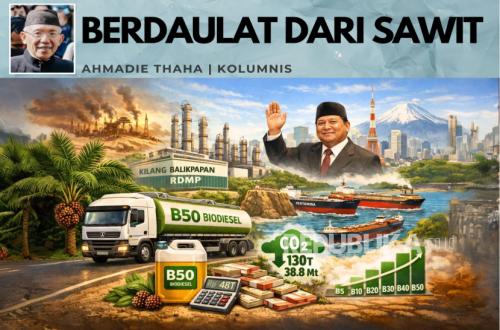
The government’s announcement of the 50% biodiesel policy—alias B50—which will soon be mandatory in the middle of this year, is not just a technocratic experiment. President Prabowo Subianto boldly affirmed it at an economic meeting in Japan.
This is like a family head’s decision who is tired of buying expensive gas and starts planting trees in the yard. Through B50, half of our diesel will come from palm oil.
That means every truck speeding along the North Coast Road isn’t just carrying goods, but also a bit of the aroma from palm plantations in Sumatra and Kalimantan. Every ship sailing the seas and heavy construction equipment will also get a share of that aroma.
On paper, the numbers are enticing. Through the use of B50, fuel subsidy savings in 2026 are estimated to reach around Rp48 trillion in just half a year of implementation. That means double in a full year.
Fossil fuel use can be reduced by around four million kilolitres per year. For comparison, with the previous B40 scheme alone, diesel imports had dropped by about 3.3 million kilolitres.
That resulted in foreign exchange savings of up to Rp130 trillion, and emissions reduced by up to 38.88 million tonnes of CO2 equivalent. If B50 runs consistently, the impact is clearly not small. This is not just about saving, but a shift in energy structure.
However, beyond the numbers, there’s one social phenomenon that’s no less interesting: the public doesn’t believe it. Many people are convinced that petrol prices—especially Pertamax—will definitely rise starting this April.
Memes are everywhere, from subtle jabs to ones spicier than devil’s chilli. The logic is simple. So far, we’ve been too dependent on energy imports that choke the budget.
Moreover, there are rumours that two Pertamina tankers were briefly held in the Strait of Hormuz—a narrow chokepoint where even a slight cough can send global oil prices into a high fever. So it’s understandable if the public thinks: “Ah, it’ll rise anyway.”
And this is exactly where B50 starts to come in as the explanation that’s been missing so far. For the first time, the public sees that there’s a new variable in the national energy equation.
It’s true that B50 hasn’t touched petrol like Pertamax yet. It’s still playing in the diesel realm. But don’t underestimate diesel. It’s the main blood of logistics: trucks, ships, heavy equipment.
When diesel costs can be curbed through palm oil substitution, distribution costs also drop or at least are held back. This is where the balancing effect emerges. Energy prices may not drop drastically, but not rising is already good news.
It’s worth remembering that B50 didn’t emerge from a vacuum. It’s the current final step in Indonesia’s long biodiesel journey. We went through the B5 phase, when palm oil mixtures were just small experiments.
Then up to B10, B15, to B20 which started being implemented nationally in earnest. The peak before this was B30 and then B40, which have proven able to suppress imports and save foreign exchange on a large scale.
So B50 isn’t a reckless leap, but a logical continuation of a long experiment that’s slowly turning into permanent policy. Like learning to ride a bike, we’ve fallen many times at B5 and B10, and started balancing at B20, and now cruising more steadily at B50.
That President Prabowo Subianto announced B50 in Japan is because energy was being discussed there. When Indonesia talks B50 in Tokyo, it’s like sending a subtle message: “We’re learning to be independent, but still open to cooperation.”
So, if there’s a common thread, it’s not in production, but in bargaining position. Indonesia no longer comes just as an energy buyer, but as a player that’s starting to have its own strategic reserves.
Now, amid all that, one term emerges that sounds like the name of a sci-fi film project: RDMP East Kalimantan. But this is real, concrete, and smells not futuristic, but of diesel.