
Southeast Sulawesi High Prosecutor's Office deposits Rp9.9 billion from mining cases into state coffers
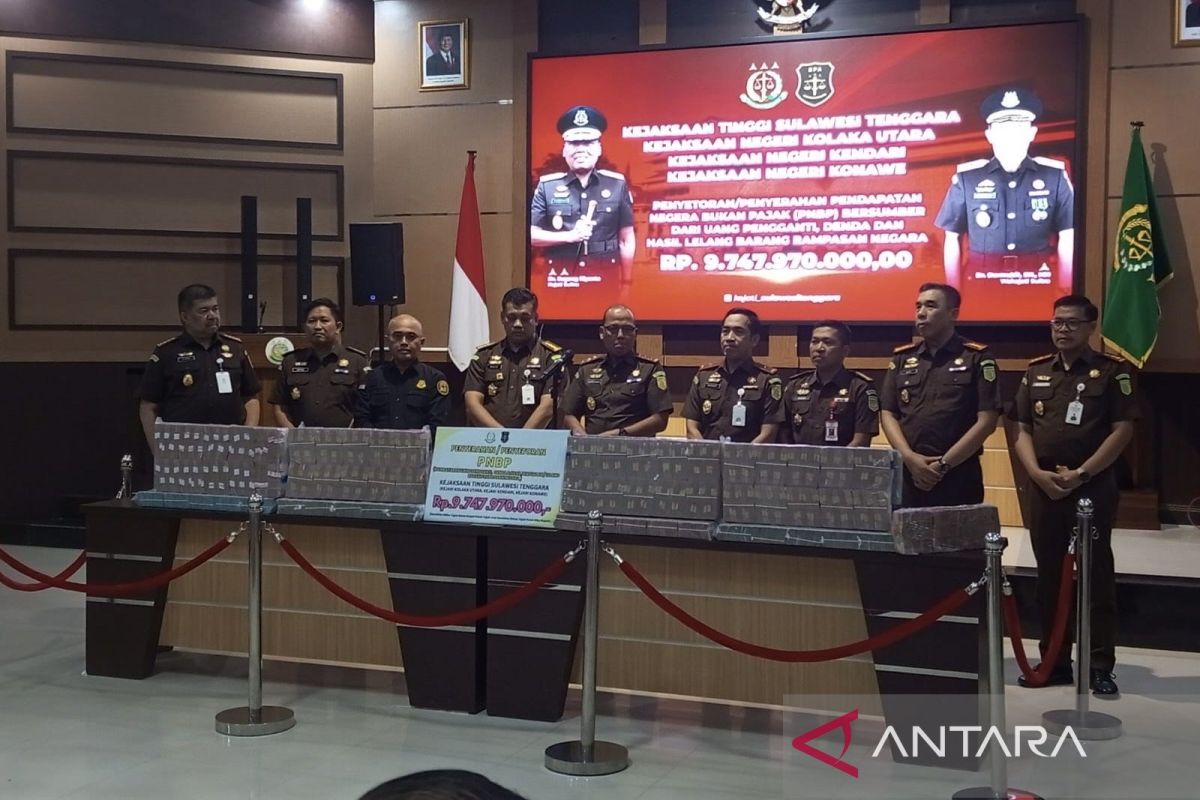
The Southeast Sulawesi High Prosecutor’s Office (Kejati Sultra) has handed over Non-Tax State Revenue (PNBP) worth Rp9.97 billion to the state treasury, sourced from restitution payments in a mining corruption case and the proceeds from the auction of seized assets. Head of Kejati Sultra, Sugeng Riyanta, stated in Kendari on Thursday that the PNBP deposit reflects tangible, accountable law enforcement through the handling of corruption and general crime cases that have attained permanent legal force. ‘The total non-tax state revenue we deposited into the state coffers on this occasion amounts to Rp9.97 billion,’ Sugeng said during a press conference at the Kejati Sultra Building. This case was handled collaboratively by Kejati Sultra investigators together with the North Kolaka District Prosecutor’s Office. The remaining amount originates from the payment of corruption case fines totalling Rp260 million, as well as the auction proceeds of state-confiscated goods and cash seized from various criminal cases across several district prosecutor’s offices under Kejati Sultra’s jurisdiction. He explained that several assets successfully auctioned through the Kendari State Assets and Auction Service Office (KPKNL) included two vehicles from a general crime case handled by the Kendari District Prosecutor’s Office, which sold for Rp457.05 million. Additionally, three vehicles seized from a general crime case managed by the Konawe District Prosecutor’s Office were successfully auctioned openly, fetching Rp310.92 million. ‘Cumulatively, when combined with other routine realisations, Kejati Sultra together with all district prosecutor’s offices across the Bumi Anoa region recorded an overall PNBP realisation for the First Semester of 2026 of Rp11.54 billion,’ he added. He further noted that recovering state finances has now become a primary orientation and focus within every line of law enforcement undertaken by the Adhyaksa Corps. According to him, this success in safeguarding state funds serves as evidence that the prosecutor’s office does not solely focus on repressive measures or corporeal punishment for offenders. ‘This demonstrates that modern law enforcement is not only oriented towards punishing perpetrators (follow the suspect), but also towards how state assets and losses can be optimally recovered (follow the money), to subsequently be deposited into the state treasury and reused for the benefit of the wider community,’ said Sugeng Riyanta.