
South Korean Won Falls to Weakest Level in 17 Years, What's the Situation in Korea?
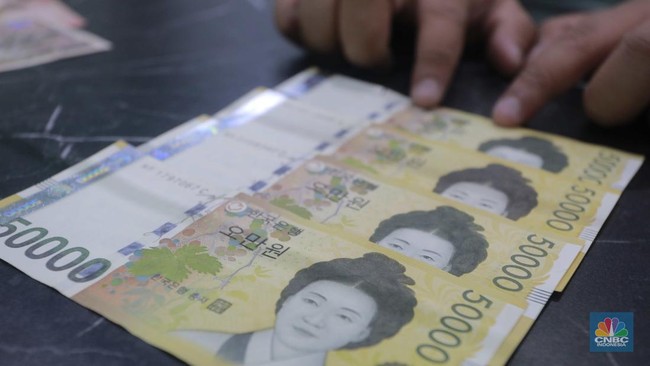
Jakarta, CNBC Indonesia - The exchange rate of the South Korean won temporarily reached its weakest level in 17 years against the US dollar. According to Refinitiv data, the South Korean won closed down 1.38% at KRW 1,517.3/US$ on Wednesday’s trading (18/3/2026). That level became the weakest since March 2009, or the worst in the last 17 years. Pressure on the won emerged amid escalating conflicts in the Middle East, which prompted global market participants to exit risk assets and shift to the US dollar as a safe-haven asset. Nevertheless, in its last trading close on Tuesday (24/3/2026), the won remained in the red zone, closing depreciated by 0.63% at KRW 1,496.03/US$. Over a longer period, viewed over the past 12 months, the won has also recorded a 1.98% weakening against the US dollar. Reasons for the Won’s Weakness One of the main causes of the South Korean won’s weakening is the increasing risk-off sentiment in global markets. When geopolitical tensions heat up, investors tend to avoid risky assets and move funds to instruments considered safer, particularly the US dollar. This condition increases demand for the dollar, while Asian currencies, including the won, are also pressured. In addition to the safe-haven factor, the won is also pressured by the heavy outflow of foreign capital from the South Korean stock market. Throughout March, foreign investors recorded net selling in the South Korean stock market of around US13.5billion, equivalenttoRp152.01trillion(assuminganexchangerateofRp11, 260/US). This selling action adds further pressure on the won, as funds from stock disposals are generally converted to US dollars before exiting the domestic market. The foreign fund outflow occurred alongside growing market concerns about the impact of the war in the Middle East on global energy supplies. Foreign selling actions were heavily concentrated on technology stocks that had previously recorded significant gains thanks to the artificial intelligence (AI) boom. When leading Korean stocks are sold off by foreign investors, the pressure is not only felt in the capital market but also spills over to the won’s exchange rate. Moreover, energy supply disruptions have caused oil prices to surge sharply, triggering concerns about an oil shock and the risk of stagflation, a condition where inflation remains high amid economic slowdown. This sentiment is bad news for South Korea, which is a net energy importer. Rising oil prices could enlarge the import burden, drive inflation, and pressure economic growth prospects. In other words, the won’s weakening is not only triggered by the strengthening US dollar but also by concerns that the energy price surge will burden South Korea’s domestic economy. Thus, the weakening of the South Korean won occurs due to a combination of several factors at once, from the increasing demand for the US dollar as a safe asset, the outflow of foreign funds from the stock market, the oil price surge due to the Middle East conflict, to concerns about South Korea’s economic prospects as an energy-importing country.