
Something's Amiss! Once the World's Sugar King, Indonesia Now a Perpetual Importer
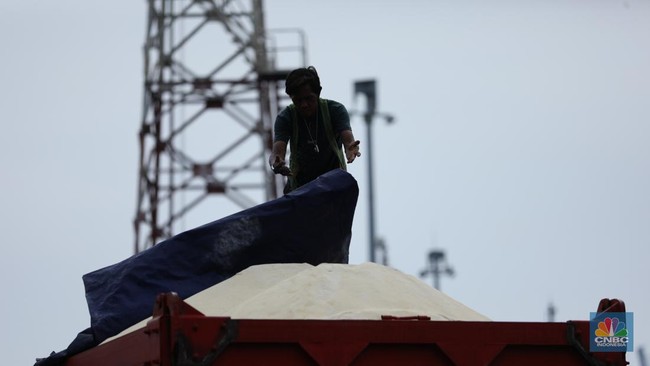
Jakarta, CNBC Indonesia - Before independence, Indonesia was the world’s second-largest sugar producer after Cuba, but now it relies on large-scale imports, even reaching millions of tonnes each year with values in the trillions of rupiah. This situation reflects the weakening competitiveness of the national sugar industry amid the strong influx of imported products that has persisted for decades without resolution.
Agriculture Minister Amran Sulaiman believes that this import dependency is inseparable from past policies that excessively opened the market without adequate protection for domestic production.
He described the imbalance as an uneven contest, where local products struggle to compete with imports.
“It’s like Mike Tyson facing Ellyas Pical but without a referee—that’s the picture. Now we must control this (with lartas), because we accepted the IMF’s (International Monetary Fund) advice on free markets, with no lartas,” said Amran during a Working Meeting with Commission VI of the House of Representatives at the Parliamentary Complex, Jakarta, on Wednesday (8/4/2026).
According to him, policies based on International Monetary Fund (IMF) recommendations have caused the agricultural sector, including sugar, to lose resilience. Without prohibition and/or restriction policies (lartas), cheaper and massive imported products have flooded the domestic market.
“This is just our view, Madam (chair of Commission VI of the House of Representatives), that this is (the fault or because) we accepted the IMF’s advice raw, and the agriculture became a mess. Now we’re fixing it one by one,” he explained.
Amran emphasised that this dependency pattern does not only occur with sugar but also with other commodities. However, in the context of sugar, the impact is evident from the high recurring import figures each year.
Data from the Central Statistics Agency (BPS) shows that Indonesia’s sugar imports throughout 2025 reached 3.93 million tonnes.
“In total, in 2025 we imported this sugar commodity under Harmonized System (HS) Code 1701 amounting to 3.93 million tonnes,” revealed Deputy Head of BPS Sonny Harry Budiutomo Harmadi during the same meeting.
He added that Indonesia’s sugar imports still depend on several major supplying countries, including Brazil.
“Indeed, our imports mostly come from several countries, including Brazil,” he said.
Looking back, the trend of Indonesia’s sugar imports has even been high in recent years. From 2017 to 2024, the import volume ranged between 4.5 million and 6 million tonnes per year.
In 2017, Indonesia’s sugar imports were recorded at 4.48 million tonnes, in 2020 at 5.53 million tonnes, in 2023 at 5.06 million tonnes, and in 2024 reaching 5.31 million tonnes. Even in 2022, imports reached 6.007 million tonnes, the highest in volume.
In terms of value, sugar imports also swelled to billions of US dollars. In 2024, the value was recorded at US$3.028 billion or around Rp51 trillion, reflecting the significant foreign exchange burden that must be borne to meet national sugar needs.
On the other hand, domestic production actually shows improvement. BPS recorded that white crystal sugar (GKP) production rose 8.22% to 2.67 million tonnes in 2025, driven by an increase in the harvested area of sugarcane.
“This was also influenced by the increase in the harvested area of sugarcane from 521 thousand hectares to 563 thousand hectares in 2025 or up 8.17 percent. Then followed by a decline in household consumption. So we have the capability to increase production on one side, on the other side we are experiencing a decrease in household sugar consumption,” explained Sonny.
Nevertheless, this production increase is not yet sufficient to reduce imports.
“In total, we still imported 3.93 million tonnes, and in general, our domestic supply is improving, but we still have dependency on imports,” he said.
Meanwhile, Trade Minister Budi Santoso also revealed that dependency does not only occur with consumption sugar but also with its derivatives such as ethanol.
In 2025, the Ministry of Trade has issued 13 import approvals for other fuels or ethanol with an allocation of 13,284,141 litres and realisation of 2,373,594 litres or 17.87%.
“For 2026 up to 30 March 2026, 6 import approvals for other fuels or ethanol have been issued with an allocation of 6,937,565 litres and no import realisation yet,” said Budi.
Looking at this situation, the government is beginning to push back for lartas policies to balance the market. This step is expected to reduce import dependency while restoring the glory of the national sugar industry that once thrived but is now eroded by the strong flow of imports.