
Solar-Powered Lighting Arrives as Cilamaya Fishermen Now Go to Sea More Safely and Productively
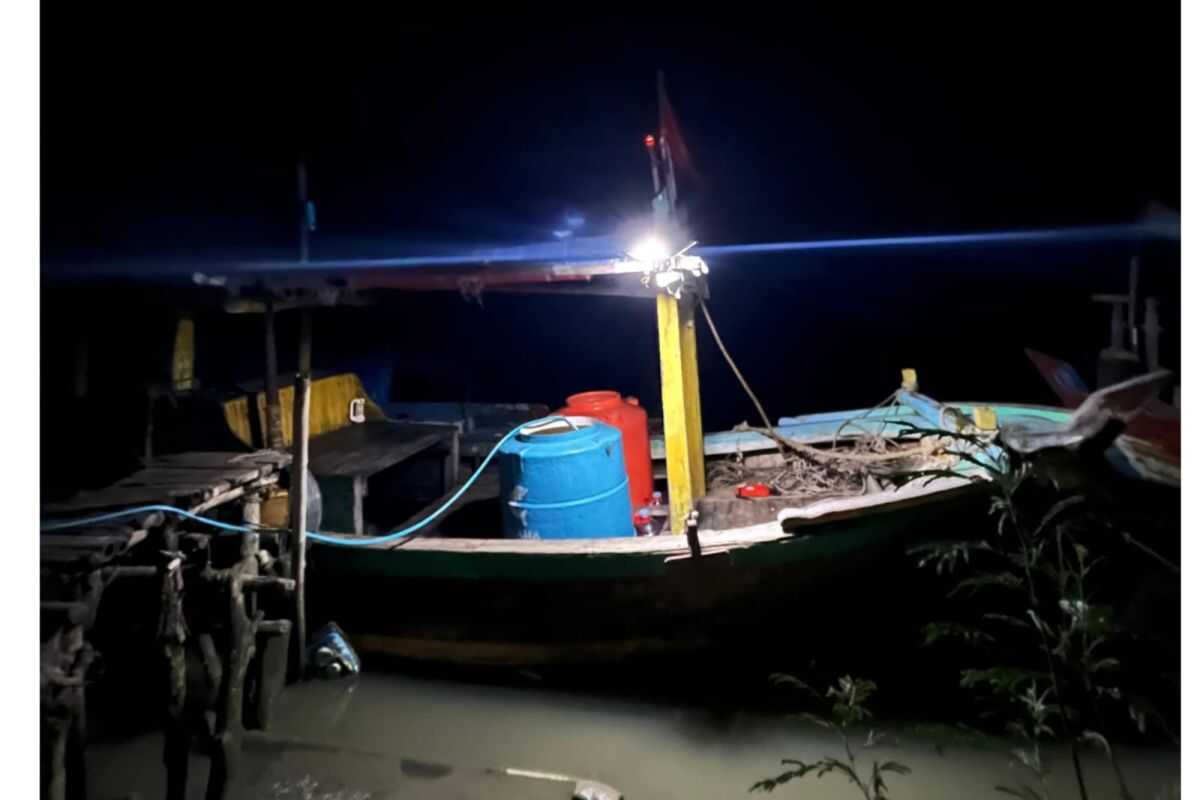
Karawang, West Java (ANTARA) - The night sky along the Cilamaya coast has not always been kind to small-scale fishermen. In the darkness of the sea, a beam of light often proves decisive — determining whether nets can be cast safely, whether boats can navigate without risk, and whether the catch will be sufficient to bring home to one’s family. For coastal fishermen, darkness has been an everyday challenge inseparable from their profession.
Now, that story is gradually changing. Through its Corporate Social and Environmental Responsibility (TJSL) programme, Pertamina New & Renewable Energy (Pertamina NRE) has introduced solar-powered lighting systems (PLTS) to support nocturnal fishing activities. The assistance comes in the form of portable solar lighting packages installed on fishing boats. The system comprises solar panels placed on the upper section of the boat to capture sunlight during the day, energy storage batteries, and lighting that can be used throughout the night. Energy collected during daylight hours is stored in batteries, then utilised as a power source for the onboard lamps when fishermen go to sea at night.
This simple form of assistance has delivered tangible impact, from increased productivity to reduced operational costs.
Budiman, a fisherman who has been going to sea since 2000 and is recognised as a Pertamina Local Hero in his village, has experienced the transformation first-hand. Previously, he relied solely on a head torch when fishing at night. Besides being tiring, the device frequently malfunctioned when exposed to water.
“Now the lighting is very bright and consistent from night until morning. Previously, because of fatigue and worry about the lamp failing, I could only cast my nets a few times. With solar power, I can manage five or six times a night. My income has noticeably increased,” he said.
A similar account comes from Kiki Mulyana, a small-scale fisherman who has spent 10 years at sea. He previously depended on lead-acid batteries that were prone to failing when exposed to water and required costly replacements.
“With solar energy, we save far more. The lighting coverage is wide, helping us sort fish and also aiding navigation to prevent accidents, especially on narrow river channels. Even on land, the solar lighting can be used for mending nets, given how easy it is to assemble and disassemble. This has greatly helped us economically and in carrying out our daily lives,” Kiki explained.
For fishermen in areas that still lack adequate lighting, the presence of solar power systems not only supports their work at sea but also eases household expenditure burdens. Solar energy has become a reliable and environmentally friendly solution.
Acting Corporate Secretary Rizki Vistiari affirmed that the programme was designed to deliver direct benefits to coastal communities. “We believe the energy transition must deliver tangible impact at the grassroots level. Through the utilisation of solar energy, we want to help fishermen improve their safety, productivity and welfare. This is a manifestation of Pertamina NRE’s commitment to growing together with the community,” she said.