
Solar Power Panel from UPI Lights Up Fatima's Home at Night
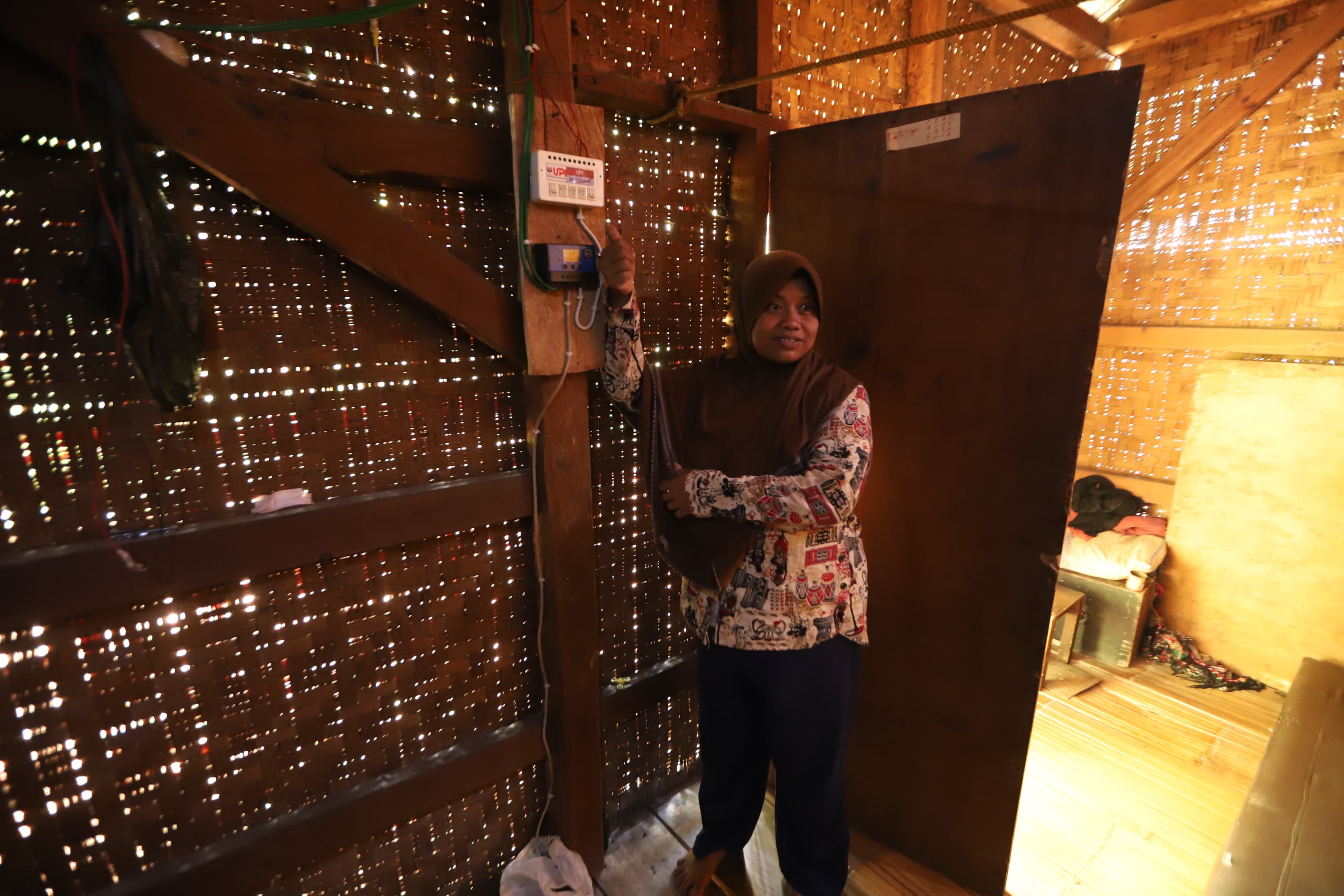
Evening always arrives quickly at Fatima’s house in Mekarsari Village, Rongga District, West Bandung Regency (KBB), West Java. When the sun begins to set behind rows of pine forest, the small wooden stilt house, measuring just four by four metres, would typically sink into darkness as well.
For years, that was the reality. There was no electricity. There were no lights. Only torch light or candles illuminated the bamboo-walled home.
Now the situation has changed. A small lamp lights up every evening in the house, burning steadily and brightly enough to illuminate the simple family room where Fatima lives with her husband and two children.
The light comes from a solar power panel installed through a support programme from Universitas Pendidikan Indonesia (UPI) for disadvantaged families in the village. “Alhamdulillah, there is now lighting. The children can study in the evening,” said Fatima with a beaming face.
This small change may seem ordinary to many people. However, for a family that has lived without electricity for more than 15 years, an evening lamp light becomes something of great significance.
REACHING REMOTE VILLAGES
A delegation from UPI, led directly by UPI Rector Didi Sukyadi, visited Mekarsari Village to observe the impact of the solar power panel installation programme for disadvantaged residents. “This programme is part of UPI Berdampak LIMAR (Independent Electricity for the People), a community service initiative aimed at improving energy access for residents who lack adequate electrical lighting,” said Didi.
According to Didi, through this programme, solar power panels are installed in homes of residents who have previously lived without access to electricity. In addition to monitoring panels that residents have used over the past few months, the UPI team also installed new panels in the homes of two other families. The programme is expected to serve as a simple yet effective solution for communities in areas far from the main electricity network.
“In many remote areas of Indonesia, the problem of energy access remains a major challenge. Solar panels are one relatively easy-to-implement alternative because they harness energy from a source available throughout the day: the sun,” he said.
PINE FOREST AREA
Fatima’s house stands in the midst of a quiet pine forest area. To reach it, visitors must walk along an uphill footpath. The small wooden stilt house is approximately 4 by 4 metres in size. Its walls are made of bamboo slats, and its wooden floorboards are beginning to wear. In the kitchen area, the ground serves as a floor where a wooden stove is used for cooking. In the small yard beside the house, four goats entrusted to Fatima by neighbours are kept in a simple pen.
Fatima and her husband care for the goats as additional income. Her husband works as a pine resin tapper in the forest surrounding the village. This work does not always generate steady income. When the rainy season arrives, earnings often decline.
In this simple home, Fatima raises two children.
“My first child is a 13-year-old girl who is now in her second year of junior secondary school. My second child is a six-year-old boy still in his second year of primary school. For years, our evening life has been very limited. ‘In the evenings, we usually use torches or candles. We study mostly during the day,’ said Fatima.
Torch light provides dim illumination that is not bright enough for studying. For this reason, her children rarely opened books in the evening.
HOW SOLAR PANELS WORK
The solar panel now installed at Fatima’s house works in a simple way. During the day, the panel absorbs solar energy. This energy is stored in a battery and then used to power the lamp at night. Now, the small lamp at Fatima’s house can stay on throughout the evening and her children can study after returning from school. “Perhaps they can study in the evening, and recite the Quran as well,” she added.
A lamp has also been installed at the front of the house so the small yard is no longer dark. Fatima said she no longer needs to carry a torch when leaving the house at night. For a family that has lived in darkness for years, this change feels very significant.
The solar power panel installed at Fatima’s house does not generate large amounts of electricity. The electricity produced is only sufficient to power a few lamps and charge a mobile phone. However, for a family that previously had no electricity whatsoever, this facility is extremely helpful. In clear weather conditions, electricity from the panel can be used throughout the night. However, when it rains for several days in a row, usage must be rationed.
“When the weather is cloudy, we usually only turn on two lights so they don’t run out quickly. Despite this, over several months of use, the solar panel has worked well. Alhamdulillah, it runs smoothly with no problems,” she explained.
CLEAN WATER ACCESS
Although electricity is now available, life at Fatima’s house remains far from easy. Access to clean water remains a problem. The water source is quite far from her house, and the route to it is often slippery, particularly during the rainy season. Some time ago, the water route was even temporarily blocked by a bamboo landslide. “My hope is that in the future there will be assistance to provide access to clean water,” she said.
She hopes that one day a clean water source will be closer to her house so she does not need to walk far each day.
On the same occasion, Fatima expressed her gratitude to UPI, particularly the UPI Rector, for helping to provide the solar panel at her house, so that after many years without access to electricity, she now has independent power. “I thank UPI and the Rector who has helped so my home now has independent electricity, so at night the children can study because it is now bright,” she said.