
Soemitronomics Deemed Key to National Economic Sovereignty
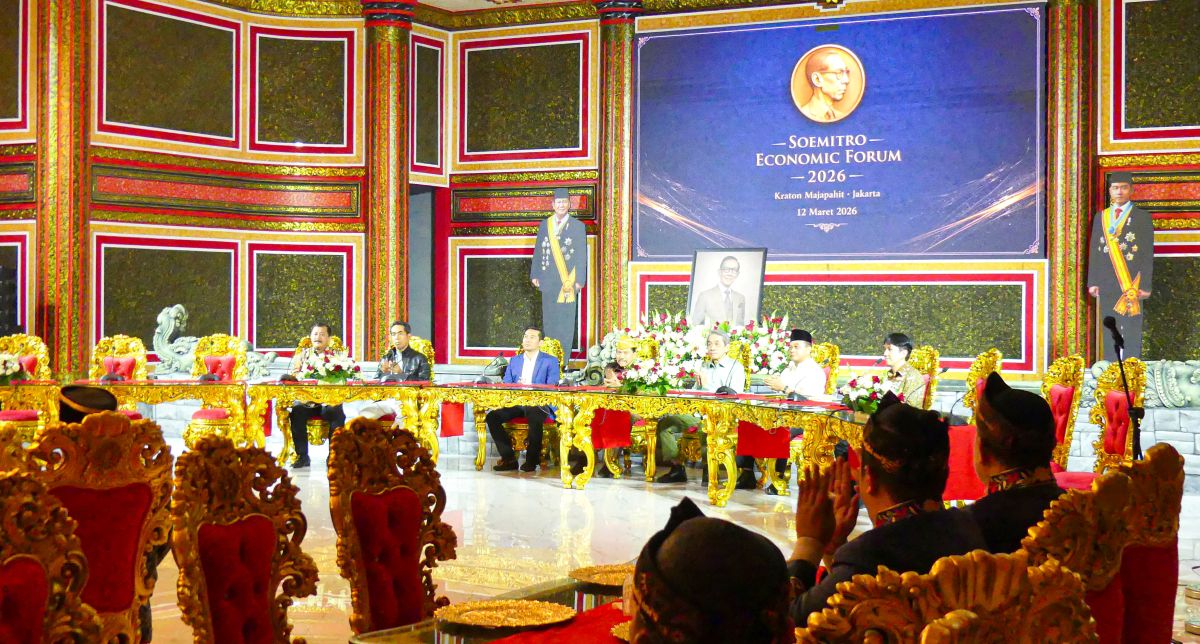
Amidst global economic turbulence resulting from the United States-Israel conflict against Iran, the economic philosophy of Soemitro Djojohadikusumo is being recognised as the key to national economic sovereignty. This emerged during the Soemitro Economic Forum II, titled “Reflections on 500 Days of President Prabowo Subianto’s Administration: The Return of an Economy Serving the People,” held at Kraton Majapahit in Jakarta on Thursday, 12 March 2026.
The forum, initiated by the Indonesia Roundtable of Young Economists (IN.RY), also commemorated the 25th anniversary of the passing of Soemitro, the legendary economist renowned for consistently championing national economic sovereignty.
Former BIN Chief AM Hendropriyono, in opening the forum, stated that the concept of “Soemitronomics” is a strategy for national revival. He emphasised the importance of building national capitalism in which the state acts as director and protector of domestic economic forces.
“The core of his thinking is building national capitalism that serves the interests of the nation. The state acts as director, private national enterprise as the primary actor, and Indonesia’s natural resources as the foundation for industrialisation,” said Hendropriyono.
Askrindo General Director M. Fankar Umran highlighted the impact of Middle East conflict on global supply chains. According to him, this situation presents an opportunity for Indonesia to undertake domestic reforms and strengthen the manufacturing and logistics sectors based on Foreign Direct Investment (FDI).
“Soemitro emphasised that economic independence is not merely a number, because figures can be enjoyed by only a handful of people. We need industrialisation and rational economic nationalism; every investment must generate technology transfer and strengthen human resources,” explained Fankar.
In agreement, Quantum Physics expert Dr. Kun Wardana emphasised the importance of data sovereignty in the 21st century. He likened the data of Indonesia’s 280 million population as an asset that must not be left to foreign processing without domestic control.
A cadre and former aide on political-economic affairs to Soemitro, Nehenia Lawalata, assessed that President Prabowo Subianto’s current steps represent a genuine implementation of Soemitronomics teachings. Several policies highlighted include the establishment of Danantara as the central authority for state economic forces, the development of Red-and-White Village Cooperatives, and the Free Nutritious Meals Programme.
“The challenges are significant because there are groups that do not wish Indonesia to be sovereign. Soemitronomics is not merely profit, but ensuring that both small and large enterprises alike are sovereign through state guidance,” said Nehenia.
A member of the House of Representatives and grandson of Soemitro, Rahayu Saraswati Djojohadikusumo, appreciated the relevance of her grandfather’s thinking in facing a period of global “re-setting.” She emphasised that economic forums must be data-based and capable of translating macro policies into language understood by ordinary people.
“I see development from below, from villages, beginning to bear fruit. Data shows that e-commerce transactions are now increasingly occurring in villages, conducted by farmers. This proves that the vision of bottom-up development is underway,” said Sara.