
Social Ministry Strengthens ASN Management for Teachers in People's Schools
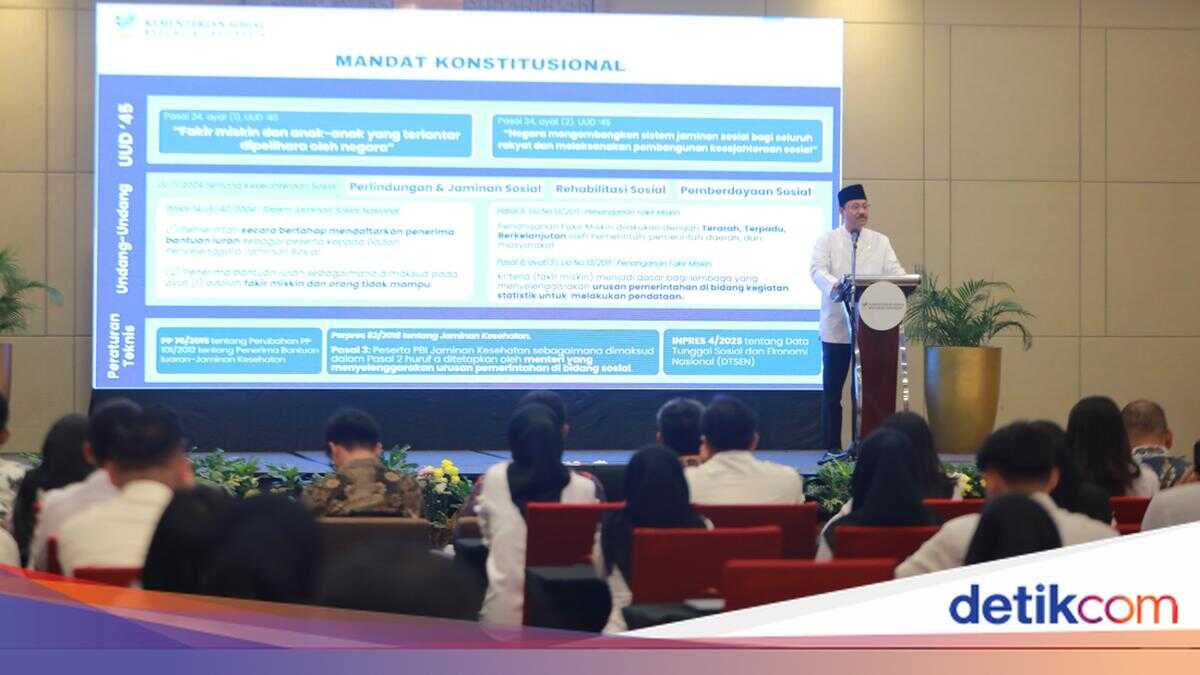
The Ministry of Social Affairs (Kemensos) held an event entitled ‘Acceleration of Performance Target Preparation and Strengthening ASN Management for Teachers in People’s Schools’ at the Indonesia Convention Exhibition (ICE) in Bumi Serpong Damai (BSD), Tangerang, on Thursday (26/2).
Minister of Social Affairs, Saifullah Yusuf, also known as Gus Ipul, affirmed that the event was held to strengthen the performance of teachers in People’s Schools.
“This is about how they create daily reports regarding the progress of students in People’s Schools and how the impact can be measured in the future,” said Gus Ipul in a statement on Thursday (26/2/2026).
Gus Ipul explained that the training was also designed to build a work culture and foster integrity among teachers in carrying out their duties professionally, whether supervised or not.
During the event, Gus Ipul, accompanied by Secretary-General Robben Rico, provided guidance to representatives of 306 teachers from 166 People’s School locations across Indonesia. The opening session featured a screening of an inspiring video showcasing students from People’s Schools.
The teachers appeared impressed and amazed to see that children who were previously excluded from education could now pursue their dreams in People’s Schools. They were reminded that the teachers are the President Prabowo Subianto’s representatives, helping children from poor families achieve their dreams.
In his address, Gus Ipul explained the background of the establishment of People’s Schools as a shared guideline. According to him, this is part of the President’s effort to implement Article 34 of the 1945 Constitution.
“They are there but invisible; these ‘invisible people’ are all around us. The President invites the nation to identify them as an implementation of Article 34. Let us reflect on this together,” said Gus Ipul.
“This is a mandate from God to the state, and the state entrusts it to us. This is an opportunity and a challenge,” he continued.
He emphasised that the management of People’s Schools should not be ordinary.
“We are not managing ordinary schools; this (People’s School) is building a new path for children to break out of the cycle of helplessness. Therefore, the management of People’s Schools should not be ordinary.”
Gus Ipul then linked this broader context to the importance of preparing Performance Targets for Civil Servants (SKP). He emphasised that the SKP is not just an administrative obligation but is intended to ensure that People’s School teachers remain professional.
He stressed that the SKP is not merely an administrative document or obligation but a performance management instrument that is directly linked to the grand mission of People’s Schools, which is to break the chain of poverty through quality and character-building education.
“The grand goal of People’s Schools is clear: to break the chain of poverty through quality and character-building education. The SKP that is prepared must be able to answer what impact, change, and contribution the daily work has on this grand goal,” he said.
First, Gus Ipul invited the teachers to understand the broader context of People’s Schools. The SKP should not stand alone but must be in line with the educational vision.
Second, the SKP must be based on logic, following a clear flow of thought, starting from the processes carried out every day, the output of the work, the outcome for students, to the long-term impact. Third, the SKP must be measurable. Annual, monthly, and daily targets must be clear and concrete.
He also explained the three functions of the SKP, namely as a performance compass, a work tool, and as a driver of discipline and accountability.
“The important thing is to understand these three contexts and take that understanding home,” he said.