
Social Minister Opens Ramadan Fast With Folk School Students, Gus Ipul Reveals Qur'anic Spirit
Social Minister Saifullah Yusuf (Gus Ipul) has emphasised that there is a Qur’anic spirit underpinning the Folk School (Sekolah Rakyat) programme. The presidential priority initiative under Prabowo Subianto not only provides free educational access but also ensures the nation’s next generation does not become weak, in accordance with the message contained in Qur’an Surah An-Nisa verses 8–10.
“We were reminded by our young people reciting from the Qur’an that we must fear leaving behind a weak generation. Folk School students are part of our nation’s children who must be prepared to become a resilient, intelligent generation with character and skills,” Gus Ipul stated during the event on Friday, 27 February 2026.
The minister made these remarks during a joint Ramadan fast-breaking event with students and teachers from Folk School at ICE BSD in Tangerang City, Banten Province.
The fast-breaking ceremony was opened with a Qur’anic recitation by Fahrur Roji, a student from SRMA 33 South Tangerang, whose melodious voice created a serene atmosphere. He recited Surah An-Nisa verse 8, which carries profound meaning.
Other Folk School students showcased their talents in turn, demonstrating regional dances, delivering speeches in three foreign languages, reciting poetry, and performing choral songs.
Gus Ipul and the invited guests appeared amazed by the performances of Folk School students. He noted that though the Folk School programme had been launched only a few months earlier, tangible changes had already become evident. Children now receive better nutrition, display greater discipline and creativity, possess good character, and importantly, have overcome feelings of inferiority.
“We are grateful that the children now appear confident, no longer hesitant, and most importantly, they look optimistic about facing their future,” he said.
According to Gus Ipul, this is the most crucial point. The state must care for all its citizens—those above, those being facilitated, and those at the bottom who need protection. Folk School is part of efforts to protect those at the lowest economic level.
“We hope the Folk School programme will continue to improve in the future so our children become the resilient generation that the President envisions,” he added.
Furthermore, during this Ramadan month, Gus Ipul called upon all parties to maintain and continue fostering religious tolerance within Folk School environments. He has personally witnessed tolerance flourish in various folk schools, whether those with predominantly Muslim or non-Muslim student bodies. This achievement must be preserved and developed.
“I witnessed extraordinary education in tolerance there, as well as a spirit of togetherness. This is what we must preserve and develop so that tolerance becomes a lesson within folk schools, and we must do our utmost to prevent bullying and physical and sexual violence,” he stated.
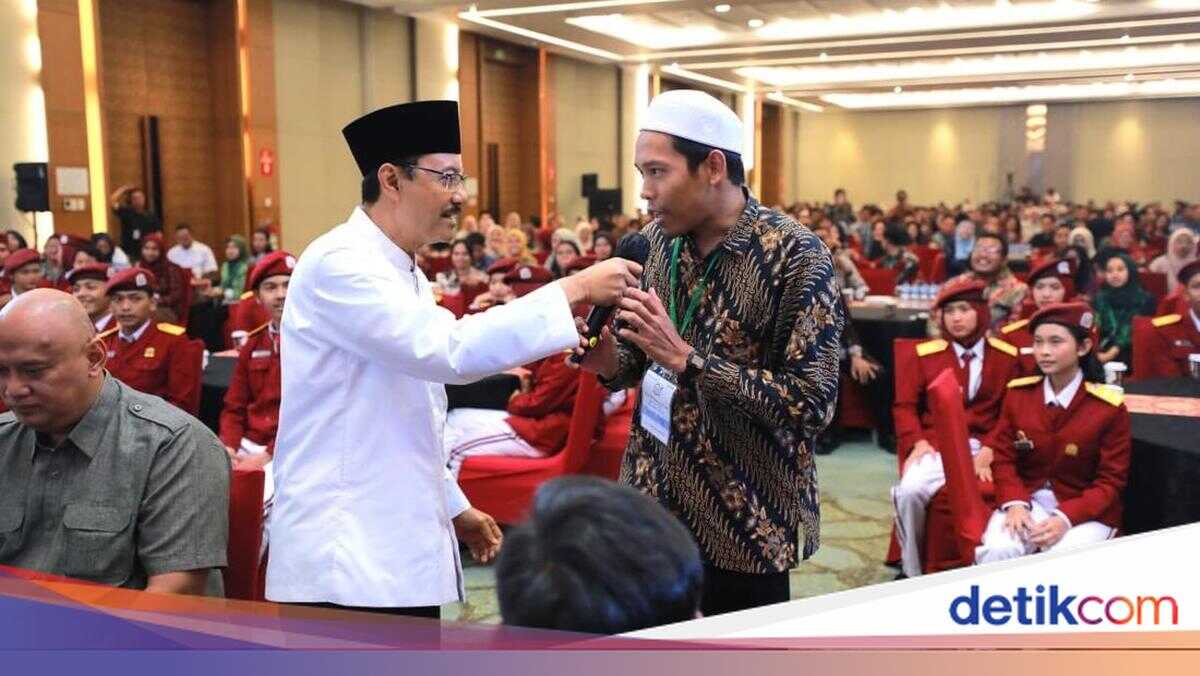
As a final demonstration of tolerance as the lifeblood of Folk School, Gus Ipul spontaneously invited a non-Muslim teacher to perform a religious song on stage.
This challenge was answered by SRT 76 teacher Ritha Christin Nara from Central Mimika, Papua, a Protestant Christian who successfully performed the song “Deen Assalam” by Nissa Sabyan with deep feeling.
Folk School is a flagship programme initiated directly by President Prabowo Subianto. The programme aims to provide free, quality education through an asrama (residential) model for children from poor and extremely poor families identified through the National Integrated Data on Socio-Economic Status (DTSEN).
Beyond educational access, Folk School is designed as an integrated poverty alleviation model as it integrates various government priority programmes, including free health check-ups, free nutritious meals, health insurance for the poor (PBI-JKN), village and sub-district red-and-white cooperatives (Koperasi Merah Putih), and a three-million-house programme for beneficiary families.
Folk School also extends benefits to students’ families. Beyond receiving social assistance such as the Family Hope Programme, basic food provisions, and the ATENSI Programme, student families are also encouraged to participate in Socio-Economic Empowerment Programmes to enable self-sufficiency and improve their standard of living.
To date, the Social Ministry overseeing this programme has successfully established 166 pilot Folk Schools with a capacity of 15,945 students, supported by 2,218 teachers and 4,889 education personnel covering elementary, junior secondary, and senior secondary levels. These schools are distributed across Sumatra (35 locations), Java (70 locations), Bali and East Nusa Tenggara (7 locations), Kalimantan (13 locations), Sulawesi (28 locations), Maluku (7 locations), and Papua (6 locations).
In the initial phase, these 166 pilot Folk Schools utilise facilities belonging to the Social Ministry, the Ministry of Labour’s vocational training centres, and local government assets. However, through the Public Works Ministry, the government has targeted the commencement of construction for 104 permanent Folk School buildings this year. The long-term target is to establish 500 folk schools, with each school accommodating 1,000 students.
Folk School also possesses distinct advantages. Students receive not only academic knowledge but also character education and skills training. A process of applied skills training has been prepared from the moment students enter Folk School through Talent Mapping DNA.
Students are guided, directed, and facilitated according to their interests, whether they wish to continue their education to higher levels or prefer to work according to their skills and expertise.
Those present at the event included the Social Ministry’s Director-General for Social Rehabilitation Agus Zainal Arifin, the Minister of Social Affairs’ Special Staff for Communication and Media Fatkhurohman Taufik, the Minister’s Special Staff for Social Welfare Services and Social Welfare Resources Abdul Malik H, Folk School teachers and students, and other Social Ministry officials.