
Social Minister Inspects STIP Jakarta's Readiness to Become Pilot People's School Site
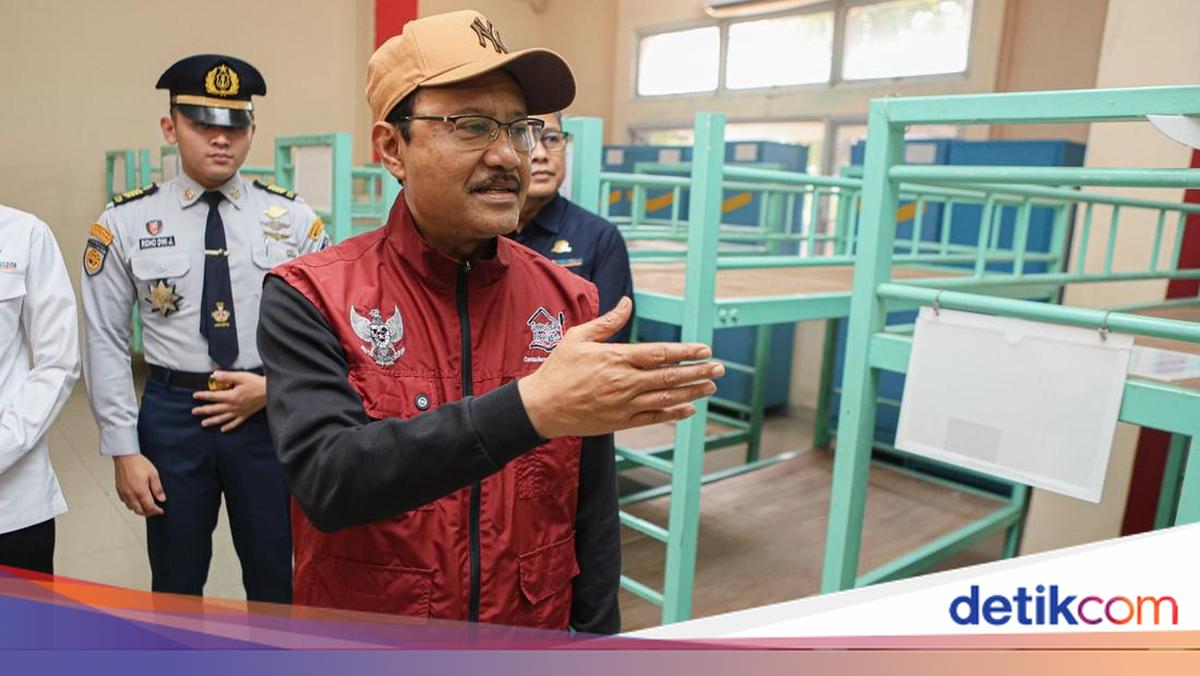
Social Minister Saifullah Yusuf (Gus Ipul) directly inspected the readiness of the Sekolah Tinggi Ilmu Pelayaran (STIP) Jakarta building. The facility will be utilised as the site for a pilot Sekolah Rakyat school.
The visit focused on checking the building’s condition while formulating improvement steps to ensure the facilities can soon be used for teaching and learning activities.
Accompanying the visit were the Director General of Strategic Infrastructure at the Ministry of Public Works, Bisma Staniarto, and the Chairman of STIP, Tri Cahyadi.
In their presentation, the technical team stated that out of a total of 56 buildings in the STIP area, four buildings and two sports facilities are permitted for use as the Sekolah Rakyat.
The four buildings are located in Asrama Taruna E, Taruna J, Wisma Bahari II, and Nautika, supported by facilities including two tennis courts and two football fields.
“For the initial stage, the prepared capacity is around 100 students, supported by two mentors and 18 teaching staff,” said Bisma in a written statement on Sunday (19/4/2026).
Survey results indicate that structurally, the buildings in the STIP area are still in very good condition. No damage was found in main parts such as foundations, columns, beams, or roofs.
From an architectural perspective, only minor damage exists, such as repairs to plastering, doors, and windows, as well as replacement of some minor components. Meanwhile, for utilities, repairs focus on replacing non-functional lights.
Given this condition, the repair process is projected to be completed in a relatively short time.
“We are optimistic that all repairs can be finalised by the end of April, and the building will be ready for use at the beginning of May,” he explained.
Besides STIP, the government is also preparing other locations, including areas owned by the National Institute of Public Administration (LAN). The condition of buildings at that site is assessed as relatively similar, with a capacity also targeted to accommodate around 100 students.
On that occasion, Gus Ipul emphasised that the Sekolah Rakyat programme continues to show positive progress. Based on implementation at 166 sites in the previous year, students experienced improvements in confidence and abilities.
Meanwhile, teachers are assessed as increasingly adaptive in identifying students’ potential and learning needs from various backgrounds.
“Over more than nine months of operation, the results have been quite encouraging. Students are starting to develop, and teachers are able to adapt teaching methods without relying on academic tests,” said Gus Ipul.
Following the President’s directives, the government targets an increase in Sekolah Rakyat capacity this year. Previously accommodating nearly 16,000 students, the number is now targeted to rise to more than 30,000 students, including through the addition of pilot schools in various regions.
Specifically for the Jakarta and surrounding areas, 10 pilot school sites have been designated, including at STIP. Overall, these locations are projected to accommodate more than 1,000 students, with an initial phase of around 700 students, followed by an additional 300 in mid-year.
Gus Ipul stressed that student selection is based on the National Socio-Economic Single Data (DTSEN), without an open registration mechanism. Outreach is conducted directly to target families to ensure the programme hits the mark.
“There must be no nepotism, no practices that violate regulations. Everything must truly target the families most in need,” he asserted.
He also assured that field challenges are relatively minimal and only require minor repairs to supporting facilities, such as beds, toilets, and dining areas.
“We are optimistic that all preparations, including minor renovations, can be completed by the end of April so that activities can begin in early May,” he concluded.