
Social and Rural Development Ministers Promote DTSEN in Karawang, Ensure Welfare Assistance Reaches Intended Recipients
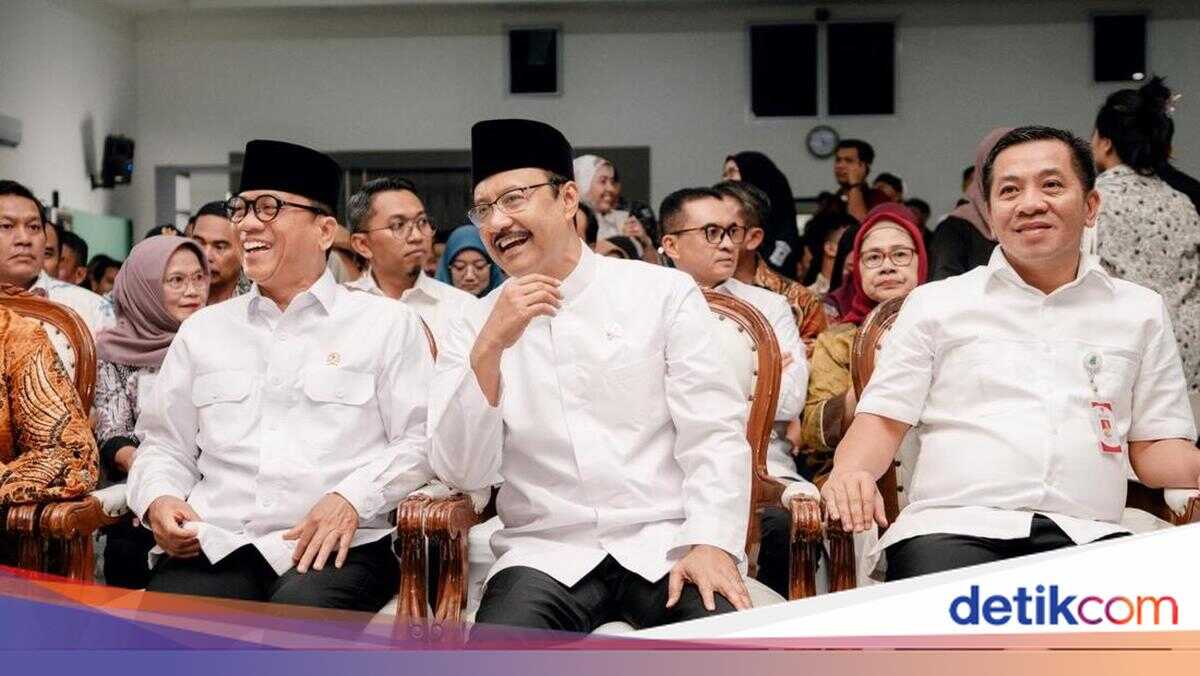
Minister of Social Affairs Saifullah Yusuf (Gus Ipul) and Minister of Villages and Disadvantaged Region Development Yandri Susanto held a socialisation event promoting the National Socio-Economic Data (DTSEN) system at the Husni Hamid Hall, Karawang Regional Government Complex, West Java.
The two ministers met with regents, village facilitators, social pillars, village heads, village data operators, provincial parliamentary members, and social volunteers to ensure data accuracy as the foundation for targeted welfare distribution and to prevent intervention by vested interests at the village level.
Gus Ipul emphasised that DTSEN serves as the primary reference for distributing welfare assistance and government programmes, both at central and regional levels, in accordance with Presidential Instruction (Inpres) No. 4 of 2025. Therefore, data updates must be conducted jointly and continuously.
“Over the past year, both Yandri and I have consolidated data to implement Presidential Instruction No. 4 of 2025, which requires us to use DTSEN as the basis for distributing welfare assistance and government programmes,” said Gus Ipul in a written statement on Friday (27 February 2026).
According to Gus Ipul, the success of DTSEN depends on cross-ministerial and local government collaboration. He also emphasised that data is dynamic in nature and therefore requires rapid, systematic, and technology-based work.
The role of village data operators is considered crucial as they are responsible for inputting field data together with local social services departments.
Gus Ipul also appreciated the support of the Ministry of Villages and Disadvantaged Region Development in encouraging villages to establish and fund village data operators. According to him, this approach strengthens the quality of data updates at the grassroots level.
“There are still shortcomings and some errors, but our data becomes increasingly solid each day, month, and year. Errors continue to decline,” said Gus Ipul.
“Especially if society becomes more aware and actively participates, I am confident that our data will become increasingly accurate. Accurate data will bring justice, with no one left behind,” he added.
He also hopes that the synergy between the Ministry of Social Affairs and the Ministry of Villages and Disadvantaged Region Development will serve as a model for other regions.
Meanwhile, Minister of Villages and Disadvantaged Region Development Yandri Susanto affirmed that the collaboration between the two ministries is aimed at ensuring transparent and verified data updates down to the village level, in accordance with Presidential Instruction No. 4 of 2025. The ministry is tasked with ensuring data updates are conducted from the grassroots level.
Data are collected by neighbourhood units (RT/RW), monitored by village facilitators and family hope programme (PKH) facilitators, inputted by village data operators, and then discussed openly through village deliberations. This mechanism, according to Yandri, is designed to prevent data manipulation at the grassroots level.
“So there is no collusion in data at the village level, and this means DTSEN accuracy will improve each passing day. We must ensure that those who deserve to receive assistance actually receive it, and those who do not deserve it do not receive it,” said Yandri.
“This is what we want to eliminate, with the key being at the village level,” he added.
Yandri reminded that out of Indonesia’s total of 75,266 villages, data is highly dynamic, ranging from births and deaths to residential relocations and changes in welfare status. Therefore, data updates must be continuously conducted.
“This dynamic nature of data must be addressed through collaboration between ministries and agencies present at the village level, so that when the data is correct, it can be properly used to distribute welfare assistance or other affirmative programmes for development,” said Yandri.
The event was also attended by Karawang Regent Aep Syaepuloh, Intan Jaya Regent Aner Maisini, Commission VIII Member of the Indonesian House of Representatives Wardatul Asriah, Commission XIII Member of the Indonesian House of Representatives Rieke Diah Pitaloka, and Karawang Provincial Legislative Council Chair Endang Sodikin.
Also present were senior and junior level officials from the Ministry of Villages and Disadvantaged Region Development and the Ministry of Social Affairs, ministerial special staff, and expert staff.