
Smarter or Bigger? The Fierce Battle Behind Global Drone Technology Revealed
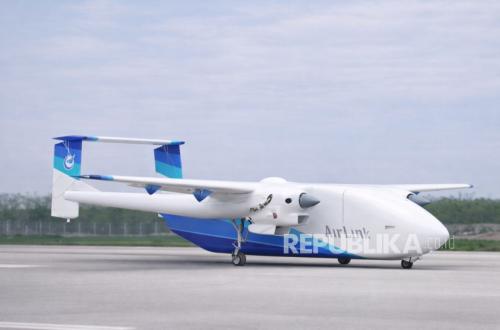
The global logistics sky is beginning to change. It is no longer filled solely with large cargo aeroplanes but also by increasingly intelligent and efficient pilotless machines.
China is once again demonstrating its ambitions. The HH-200 unmanned aerial transport system has successfully completed its maiden flight in Pucheng, Shaanxi Province, marking a new step in the development of large-scale cargo drones.
The test flight proceeded smoothly. All systems functioned normally, the flight position was stable, and all test manoeuvres were completed with performance deemed satisfactory.
Developed by the Aviation Industry Corporation of China (AVIC), the HH-200 is designed as a future logistics platform capable of reaching difficult areas.
Its design is unconventional. The fuselage is square-shaped with a high-wing configuration featuring twin engines and two propellers, emphasising functionality over aesthetics.
In terms of capacity, the HH-200 sends a clear message: China is serious about competing in the heavy class. This drone can carry up to 1.5 tonnes with a cargo volume of 12 cubic metres, expandable to 18 cubic metres.
Its cruising speed reaches 310 km per hour, with a range of up to 2,360 kilometres, sufficient to connect remote areas in a single efficient flight.
Furthermore, the use of composite materials allows for a 20 per cent weight reduction while lowering operational costs, making it more economical than conventional platforms.
What makes it even more relevant is its autonomous capability. The HH-200 is equipped with a full automatic flight system featuring AI-based obstacle avoidance.
In terms of operations, this drone is designed to be rugged. It can fly in extreme temperatures from minus 40 to 50 degrees Celsius and operate at altitudes up to 4,200 metres.
“We have adopted revolutionary structural design and manufacturing techniques, extensively utilising composite materials to achieve a 20 per cent weight reduction while lowering costs,” said Meng Fantao, technical director of the commercial unmanned transport system for the HH Xinzhou Honghu series, as reported by Xinhua.