
Smart City Becomes East Java's Weapon to Strengthen SMEs and Industry
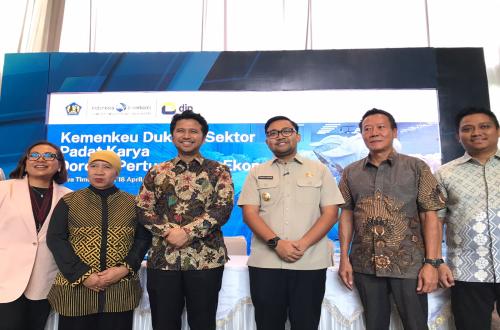
East Java Deputy Governor Emil Dardak stressed the importance of implementing the smart city concept as part of a strategy to enhance the competitiveness of the manufacturing sector and Micro, Small, and Medium Enterprises (MSMEs), particularly in East Java.
“If we’re talking about smart cities, it really comes down to how it brings benefits to the manufacturing sector. That means if the smart city makes city infrastructure management more reliable, there will certainly be benefits,” he stated during the Site Visit and Media Briefing by the Ministry of Finance themed “Ministry of Finance Supports Labour-Intensive Sectors to Support Economic Growth”, held in Nganjuk, East Java, on Thursday (16/4/2026).
Emil gave the example of QR Code implementation since 2019, which has simplified public services, including cashless vehicle tax payments. “The more we simplify public services for the community, the better our products will perform,” he added.
He also highlighted the role of digital technology and artificial intelligence (AI) in supporting MSMEs. “This morning, together with the ASEAN Foundation, we met with 500 MSME actors regarding how to use AI to improve their processes, from operations to promotion. Previously, there was a programme from the Ministry of Industry to match tech solution providers with MSME actors so they could use digital technology to increase efficiency,” explained Emil.
According to him, the government must act as a facilitator, not an obstacle, to make it easier for business actors to adapt to technology. In addition, Emil emphasised cooperation with Singapore and international industrial ministries to strengthen industrial capabilities in facing the fourth industrial revolution.
“Singapore has the Economic Development Board, and we did go there, because when the fourth industrial revolution developed, they started enhancing the capabilities of their industry actors,” he said.
He also mentioned five work programmes discussed with the Indonesian Engineers Association, including developing value-added based industries, strengthening supply chains, green development, and certifying engineer human resources to increase market confidence.
However, Emil also touched on challenges in the energy sector, particularly LPG distribution. He recounted field findings regarding hoarding practices of LPG cylinders that triggered public panic. “If the public is already panicking, the industry will find it even harder to operate. Our task in such situations is to maintain conduciveness,” he asserted.
Local governments, together with Pertamina, continue to strive to ensure smooth distribution and prevent practices that disrupt logistics.