
Small Shop Owners Seek Ministry Review on Modern Retail Expansion
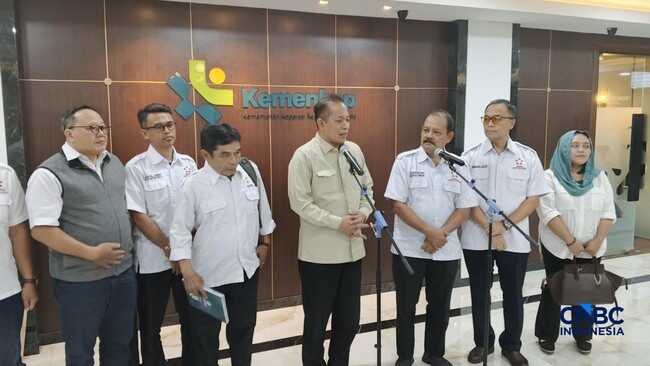
Small-scale retail shop operators visited the Ministry of Cooperatives (Kemenkop) to petition Cooperatives Minister Ferry Juliantono regarding policies permitting modern retail expansion in rural villages. The delegation, led by Ali Mahsun Atmo, Chairman of the Association of Street Vendors (APKLI), raised grievances concerning Presidential Regulation Number 112 of 2007 on the Arrangement and Development of Traditional Markets, Shopping Centres, and Modern Shops, and the Economic Policy Package of September 2015, which they argue have facilitated the proliferation of modern retailers even in remote villages, threatening the viability of traditional warung kelontong and small and medium enterprises.
“We came to petition the Cooperatives Minister to reconsider Presidential Regulation Number 112 of 2007 and the Economic Policy Package of September 2015, which have made it easier and more lenient to obtain modern retail business licences,” Ali Mahsun stated during a press conference at the Ministry’s office on Thursday, 26 February 2026.
He presented data showing a dramatic decline in the number of warung kelontong and traditional market traders since implementation of these regulations. From 2007, when there were 6.1 million such shops, the number fell to 5.1 million by 2015, and further declined to 3.9 million by 2025—a loss of 2.2 million shops. Additionally, approximately 3,500 traditional markets have closed entirely by 2025.
“Since Presidential Regulation Number 112 of 2007 and the Economic Policy Package of September 2015 were introduced, the number of warung kelontong has dropped dramatically from 6.1 million to 5.1 million by 2015, and continued declining to 3.9 million by 2025—a loss of 2.2 million shops,” he elaborated.
Ali called on the Minister to revisit Presidential Regulation Number 112 of 2007 to revitalise grassroots economic activity, particularly in rural areas. “We are requesting that the regulation be reconsidered so that the people’s economy can thrive more vigorously, especially in villages. We do not wish to be adversarial towards modern retailers, but we want the people’s economy to function, with economic sovereignty restored to the grassroots, so that village economies prosper locally rather than benefiting city centres,” he asserted.
In response, Minister Ferry stated that the government would first conduct a review to determine whether modern retailers have violated Presidential Regulation 112 of 2007. He noted that the regulation requires modern retailers to maintain a minimum distance of 500 metres from traditional markets or warung kelontong.
“If modern retailers are found to be situated less than 500 metres away or even adjacent to traditional markets, what should our position be? Should we permit the rule to be breached, or are there interests that somehow stand above these regulations? This is precisely where we must ensure fair enforcement,” Ferry said.
Despite these concerns, Ferry assured that the government would conduct a comprehensive review of both regulations. He added that the central government would conduct a review in collaboration with district and municipal governments and regional heads to seek appropriate solutions.
“Regarding Presidential Regulation 112 of 2007 and the Economic Policy Package announced in September 2015, we will have these referred for study and re-examination. We will discuss this with colleagues from the Association of Indonesian District Governments (APKASI) and regional leaders to address this issue as wisely as possible,” he explained.