
Sinking of Iran Warship: Five Questions on US Strike and Whether Southeast Asia Should Be Concerned
analysis Asia
Sinking of Iran warship: 5 questions on US strike and whether Southeast Asia should be concerned
The shadow fleet of tankers carrying sanctioned Iranian oil and operating off the coasts of Singapore and Malaysia could become targets of the US and other actors as part of the Middle East war, say analysts.
KUALA LUMPUR: The United States’ sinking of a “prize” Iran warship off the coast of Sri Lanka suggests tankers carrying sanctioned Iranian oil that sail through busy Southeast Asian waters may not be safe either, analysts say.
While Iranian warships do not make frequent visits to the region, actors looking to disrupt Iran’s income sources could target and destroy this “shadow fleet” of tankers instead, potentially creating environmental disasters and tension with coastal states in the Association of Southeast Asian Nations (ASEAN), the experts add.
For instance, the US could target commercial tankers in a military operation if Washington declares they are not being used for commercial purposes but are believed to be serving Iran’s military aims instead.
CNA reported last December that wars in Ukraine and the Middle East have pushed more of these shadow fleets of tankers into the region, according to observers. These ships carry oil from sanctioned Iran, Russia and Venezuela and transfer cargoes in the Singapore Strait to avoid detection.
They often use stolen identities and other tactics to hide their activities and evade scrutiny. Some may repaint their hulls, change flags and adopt new names to imitate legitimate ships and blend into surrounding traffic.
In 2023, Indonesia seized an Iranian-flagged supertanker suspected of being involved in the illegal transshipment of crude oil, after it spoofed its automatic identification system to show its position was in the Red Sea instead of in Indonesia’s Exclusive Economic Zone (EEZ).
According to experts, the US could also lawfully target Iran-linked merchant ships far beyond the Middle East combat theatre, if it can prove these vessels were being used for military purposes.
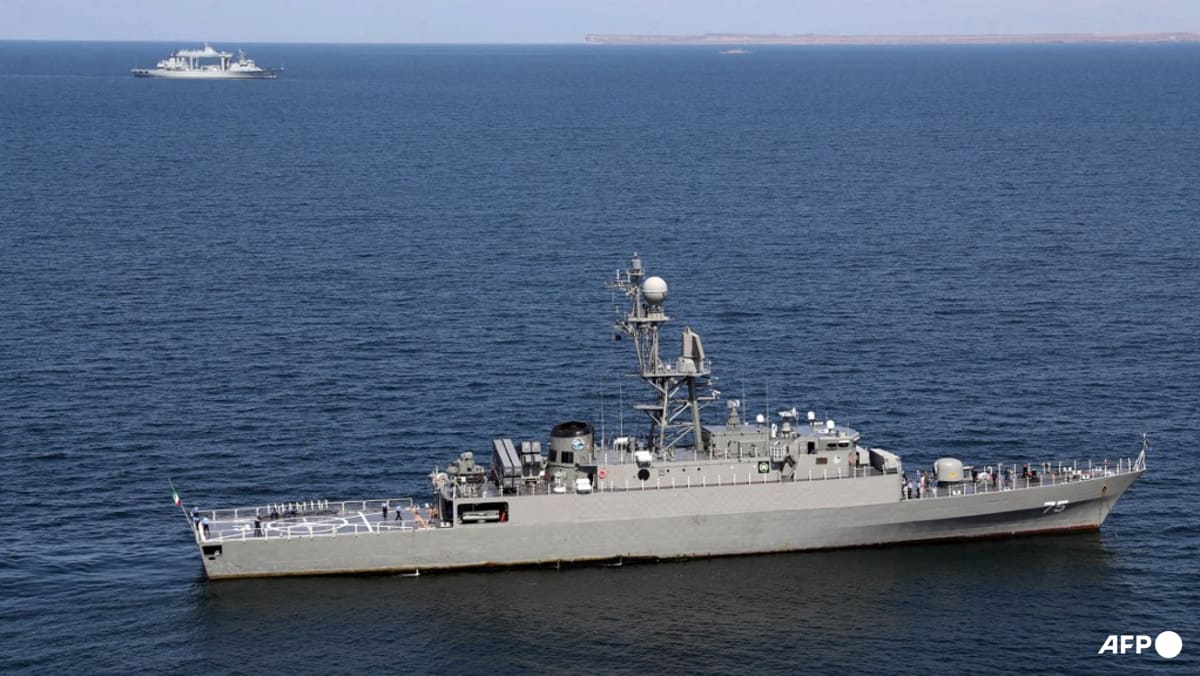
On Mar 4, a US submarine torpedoed the Iranian frigate IRIS Dena, with about 130 sailors on board, around 20 nautical miles off Sri Lanka’s southern coast. At least 87 crew members were killed, said officials from Sri Lanka, which conducted a rescue operation.
Iran said on Mar 8 that 104 crew members were killed and 32 others injured.
“An American submarine sunk an Iranian warship that thought it was safe in international waters. Instead, it was sunk by a torpedo,” US Secretary of War Pete Hegseth told reporters in Washington, calling the target Tehran’s “prize ship”.
The incident marked a dramatic expansion of the war and raised questions about the legitimacy of such a strike, including how it has impacted coastal states’ authority in their own backyard.
The United Nations Convention on the Law of the Sea (UNCLOS) defines a state’s territorial waters as extending up to 12 nautical miles (22.2km) from its baseline, with its EEZ extending up to 200 nautical miles immediately offshore.
While coastal states have resource rights in their EEZs, other states retain navigational freedoms. This means coastal states are not allowed to block Iranian or US ships from passing through.
If the Middle East conflict spreads to live strikes in the waters of Southeast Asia, regional bloc ASEAN could issue a statement condemning the move depending on where exactly it took place, although not much more especially if a major power like the US is involved, the analysts told CNA.
“Following the US Navy submarine sinking of IRIS Dena, it’s clear by now that the conflict zone can potentially widen,” said Collin Koh, a senior fellow at Singapore’s S Rajaratnam School of International Studies (RSIS).
“If the incident could take place in the Indian Ocean, and off Sri Lanka, it could definitely have the potential to replicate elsewhere.”
Here are five questions related to the US strike, and whether Southeast Asia should be concerned.
Was the US strike on Iran’s warship near Sri Lanka legal?
Under the law of armed conflict, warships belonging to a state engaged in an international armed conflict are military objectives and may be lawfully targeted.
According to the San Remo Manual on International Law Applicable to Armed Conflicts at Sea, the area of naval hostilities could be conducted well beyond the waters of the belligerent parties, including in the high seas as well as neutral states’ EEZs and continental shelves, Koh said.
The San Remo manual’s description of rules is widely recognised by legal scholars and states as an authoritative restatement of existing customary international law, including the law of armed conflict.
The Indian Navy has said that the sinking of the IRIS Dena took place about 20 nautical miles off Galle on the south coast of Sri Lanka.
IRIS Dena was one of three Iranian warships that had participated in a military exercise hosted by India between Feb 15 and Feb 21 in the coastal city of Visakhapatnam.
The Mar 4 torpedo attack places the warship outside Sri Lankan territorial sea, where “other user states could exercise freedom of navigation and as far as Washington is concerned, it includes the conduct of military activities”, Koh said.
Can the US conduct strikes in another state’s territorial waters?
However, Koh highlighted that the San Remo manual forbids hostilities in a neutral state’s territorial sea, and where applicable, archipelagic waters.
In this case, Indonesia is of “huge interest and relevance” since it is an archipelagic state as defined by UNCLOS, he said.
Under UNCLOS, an archipelagic state, or one composed entirely of islands, can draw straight baselines connecting the outermost points of its islands, designating the enclosed waters as archipelagic waters.
Within these waters, the state exercises sovereignty, subject to rights of innocent passage and archipelagic sea lanes passage for foreign vessels.
In fact, the Iranian Navy ship that was su