
Singapore Faces Potential US Penalties, Currently Under Investigation
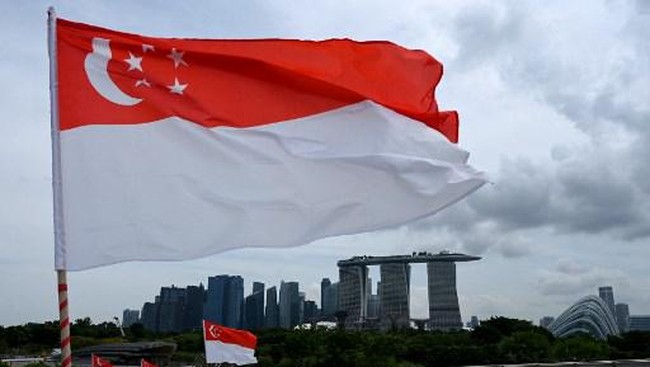
Singapore is currently under investigation by the United States (US). The Uncle Sam country is launching a trade investigation into its neighbour to Indonesia.
This relates to allegations of structural overcapacity in the manufacturing sector and the effectiveness of Singapore’s measures to prevent imports of goods produced with forced labour. The investigation in the US is led by the Office of the United States Trade Representative (USTR).
“Singapore has stated to the United States that it does not condone the use of forced labour in supply chains and has a comprehensive framework to enforce laws against such illegal practices within its territory, in response to two US trade investigations,” reads a local page, Channel News Asia (CNA), quoted on Thursday (16/4/2026).
“The Ministry of Trade and Industry (MTI) highlighted the strength and balance of Singapore’s economic relationship with Washington… The US has enjoyed a consistent trade surplus with Singapore for more than 20 years,” the page added.
It should be noted that Singapore is among 60 countries mentioned in the USTR investigation, besides Australia, Japan, South Korea (South Korea), Indonesia, and the United Kingdom. The MTI itself stated that Singapore takes a “firm stance” against forced labour and has a comprehensive legal and enforcement framework to address such practices domestically.
“Forced labour is criminalised under the Penal Code, while the Prevention of Human Trafficking Act defines it as a form of exploitation and provides penalties for violators,” the page states again.
Singapore also claims that relevant government agencies such as the Ministry of Manpower (MOM), the Ministry of Home Affairs, and the Singapore Police Force actively investigate complaints alleging violations of domestic laws. Workers can also report suspected violations through the MOM hotline, non-governmental organisations, or to the police.
“Singapore also emphasises its tripartite model, involving the government, employers, and trade unions, as a key pillar of labour protection. This framework ensures that workers are informed of their rights, employers are held accountable, and labour standards are enforced,” said the MTI.
Quoting the US Bureau of Economic Analysis, an agency under the US Department of Commerce, the US has a goods trade surplus of US$1.9 billion. The US also has a services trade surplus of US$25.1 billion with Singapore in 2024.
In 2025, both the US goods and services trade surpluses with Singapore also grew. Respectively becoming US$3.6 billion and US$29.6 billion.
In addition, data from the US Census Bureau shows that the US recorded a trade surplus with Singapore in 2024 in two of the three sectors highlighted in the USTR’s Section 301 Initiation Notice, which is the official announcement of the investigation. Namely semiconductors and electrical equipment, and pharmaceuticals.
In 2024, the US recorded a trade surplus with Singapore in semiconductors and electrical equipment of US$1.8 billion and petrochemicals of US$463 million. The trade surpluses for these sectors grew respectively in 2025 to US$3.8 billion and US$547 million.
In terms of pharmaceuticals, the US recorded a trade deficit against Singapore in 2024 of US$17.7 billion. The US trade deficit with Singapore for pharmaceutical products shrank in 2025 to US$12.9 billion.
“As evidence of the Republic of Singapore’s compliance with fair trade practices, the MTI states that during the entire period of its trade relations with the US, Singapore has only once been named as a respondent in a US anti-dumping investigation, namely in 2019,” reads another Singapore page, The Straits Times, still referring to the MTI.
“The absence of repeated or multiple anti-dumping/countervailing duty investigations and impositions against Singapore indicates that Singapore’s industrial production is generally aligned with market demand and healthy international trade norms,” the MTI statement again.