
Silver Adrift Amid Fed and Iran Shadows
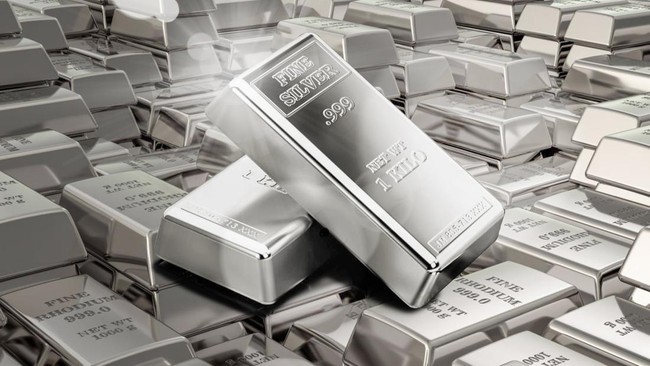
Jakarta, CNBC Indonesia – Global silver prices closed trading this week at US$76.56 per troy ounce on Friday (22 May 2026), declining marginally from Thursday’s level of US$76.69. Throughout the week, the precious metal displayed considerable volatility, touching US$73.82 on Monday before rebounding to the US$76 range.
The movement reflects a market struggling to establish direction amid two major headwinds: escalating geopolitical risk in the Middle East and concerns that the United States’ elevated interest rates may persist longer than anticipated.
Compared with the start of the previous week, silver prices have actually remained relatively stagnant. On 15 May, silver was trading at US$75.95 per troy ounce. However, this stability emerged following a brutal correction. On 13 May, silver was still trading at US$87.97 before plummeting sharply within days.
The primary pressure stems from shifting market expectations regarding US central bank policy. The US-Iran conflict has kept oil prices at their highest level in four years. Rising energy costs are prompting investors to factor in fresh inflation risks for the United States.
Markets now perceive approximately 55% probability that the Federal Reserve will resume raising interest rates by 25 basis points before October this year. Federal Reserve Governor Christopher Waller has even stated that the central bank should begin abandoning its accommodative monetary policy bias.
This situation represents unwelcome news for silver. Unlike gold, which primarily functions as a safe-haven asset, silver has a dual character.
It is viewed as a hedge asset, yet simultaneously proves highly sensitive to interest rates because it generates no yield. When expectations of rising rates strengthen, investors tend to shift towards interest-bearing instruments such as US government bonds.
Geopolitical sentiment has provided some breathing room for silver. Markets briefly hoped that US-Iran negotiations for peace would yield progress after Iranian media reported ongoing discussions concerning a war-cessation proposal.
US Secretary of State Marco Rubio acknowledged slight developments in the mediation process.
However, this optimism swiftly dissipated. A Reuters report indicated that Iran’s supreme leader remains insistent on retaining uranium stocks domestically. This stance conflicts with demands from the US and Israel, who seek uranium materials transferred out of Iran as part of a peace agreement.
The situation has become further complicated by emerging reports that Iran is accelerating restoration of its military capacity. Simultaneously, discussions have surfaced regarding establishing a permanent levy system in the Strait of Hormuz. This passage constitutes the lifeline for global oil trade. Concerns about energy distribution disruption have kept oil prices elevated and driven markets to revisit inflation concerns.
In global commodity markets, silver is now losing momentum compared to other metals. Trading Economics data indicates that on an annual basis, silver prices have indeed surged more than 125%.
However, on a monthly basis, performance remains nearly stagnant, lagging significantly behind lithium, which has jumped over 182% annually, and gold, which continues to strengthen by approximately 34%.
This situation demonstrates that investors are exercising caution regarding silver entry. The market has yet to discern whether this metal will resume its role as a primary safe-haven asset, or whether it will instead remain trapped within prolonged elevated interest rate pressure.