
Signs emerge on how APEC host China could handle Taiwan’s participation, but hardest test is yet to come
analysis East Asia
Signs emerge on how APEC host China could handle Taiwan’s participation, but hardest test is yet to come
China kept the Taiwan issue largely out of sight during last week’s APEC meeting in Suzhou, but analysts say the leader’s summit in Shenzhen this November could prove harder to manage.
SHENZHEN: The recent Asia-Pacific Economic Cooperation (APEC) trade ministers’ meeting held in Suzhou has offered an early glimpse into how China plans to navigate one of the most keenly watched issues as host this year: Taiwan.
Analysts say Beijing used the latest forum to reinforce its image as a stable, open and cooperative economic power amid rising geopolitical and trade tensions - while carefully preventing Taiwan-related disputes from overshadowing the meeting.
China is hosting APEC for the third time, after previous summits in Shanghai in 2001 and Beijing in 2014.
But this year’s meetings come against a more uncertain global backdrop, observers say - one marked by tariff disputes, slowing growth and concerns over global supply chain disruptions.
The meeting in Suzhou also came just over a week after high-profile visits to Beijing by US President Donald Trump and Russian President Vladimir Putin.
Observers noted there was “little visible friction” over Taiwan’s participation at the Suzhou meeting from Friday (May 22) to Saturday - despite Beijing’s recent criticism of Taiwanese leader Lai Ching-te over a May 20 speech that China accused of advocating “Taiwan independence” and “separatism”.
Analyst and commentator Tang Meng Kit told CNA that Beijing is using APEC to project an image of stability, pragmatism and openness, and is determined to avoid any Taiwan-related disputes that could undermine its broader diplomatic messaging during its APEC host year.
“China is positioning itself as the defender of the multilateral economic order at the moment Washington is seen as undermining,” Tang said, adding that Beijing’s objective during the recent summit between Trump and Chinese President Xi Jinping was also to preserve its export channels.
“APEC is part of broader efforts in projecting multilateral stewardship,” Tang said.
He added that Beijing’s stated APEC theme of “openness, innovation and cooperation” was “a direct counter narrative to Trump’s tariff disruptions”.
Chinese Commerce Minister Wang Wentao similarly framed the Suzhou meeting as taking place amid “escalating geopolitical tensions” and rising “unilateralism and protectionism”, saying economies were placing greater expectations on APEC to deliver stability and consensus.
The joint “Suzhou Statement”, issued at the end of the meeting, reaffirmed support for regional economic integration and deeper cooperation on supply chains, digital trade, artificial intelligence and cross-border data flows - themes observers cited as aligned closely with China’s wider diplomatic messaging this year.
Chong Ja Ian, an associate professor at the National University of Singapore (NUS) and non-resident scholar at Carnegie China, said Beijing also wants to “paint itself as the preferred partner, taking advantage of Washington’s unpredictable and volatile approach to the world at present”.
Meanwhile, Wang Huiyao, founder and president of the Center for China and Globalisation (CCG), said China hopes APEC can send a signal of stability and predictability.
But experts say things could still become more complicated for Taipei later this year.
TAIWAN’S REPRESENTATION IN SUZHOU
Made up of 21 Asia-Pacific economies including Singapore, Australia, Russia, Japan, South Korea and New Zealand, APEC was established in 1989 to promote free trade, sustainable economic growth and regional prosperity.
The forum is held annually and hosts hundreds of smaller working-level, sectoral, and ministerial meetings throughout each host economy’s “APEC Year”.
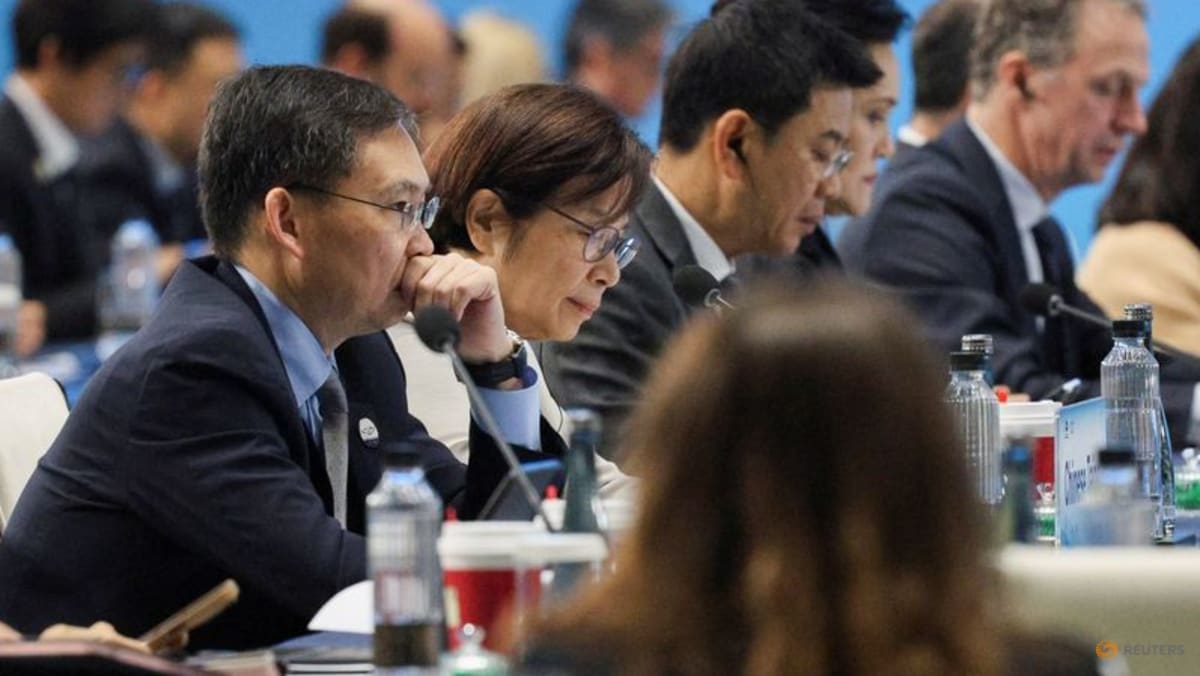
The meeting in Suzhou brought together trade envoys and representatives from all 21 APEC member economies, which included US Deputy Trade Representative Rick Switzer, Japanese Trade Minister Ryosei Akazawa, Australia’s trade minister Don Farrell and ASEAN’s secretary general Kao Kim Hourn.
It was the first ministerial-level meeting held by China as APEC host, following five others held at the officials’ level in Shenzhen, Guangzhou and Shanghai since last December, with Taipei also sending delegations to them.
APEC members are admitted as “economies” rather than sovereign states - making it one of the few international forums where Taiwan participates alongside China.
Under this framework, Taiwan has participated as a full member since 1991 under the designation “Chinese Taipei”, alongside both China and Hong Kong.
Heading Taiwan’s delegation in Suzhou was its top trade negotiator Yang Jen-ni, Taiwan’s Minister Without Portfolio and chief trade representative in charge of the Office of Trade Negotiations under the Executive Yuan.
Yang was also accompanied by Jonathan Sun, director-general of the Department of International Organisations at Taiwan’s Ministry of Foreign Affairs.
During discussions, the Taiwanese delegation “pushed a broad agenda centred on supply chain resilience, digital transformation and green growth”, according to a Taipei Times report published on May 25 - citing Taiwan’s Office of Trade Negotiations.
The delegation had also stressed that economic integration in the region should remain market-driven and aimed at creating a predictable and inclusive economic environment.
It also warned that global supply chains continue to face disruption risks from geopolitical conflicts, maritime blockages and export controls, calling for stronger efforts to enhance supply chain security and resilience.
Experts say the relatively smooth handling in Suzhou does not signal any broader softening in Beijing’s position on Taiwan.
China views Taiwan as part of its territory and has said it would not rule out the use of force to bring the island under its control.
Official communication channels between Beijing a