
Significant Drop in Red Chilli Prices in Padang Panjang, Several Commodity Prices Also Ease
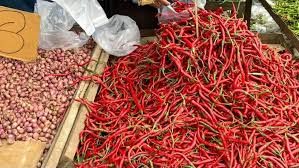
Good news for the public, prices of several commodities in the city of Padang Panjang have decreased, particularly red chilli, which has dropped significantly by Rp10,800 per kilogram, from Rp51,650 to Rp40,850/kg.
Analyst from the Padang Panjang City Government Economics Division, Chandra Erfiko, stated on Monday (30/3) that besides red chilli, several other commodities have also experienced price reductions. These include chicken eggs, down Rp133 from Rp29,735 to Rp29,602/kg, cayenne pepper down Rp2,484 from Rp43,834 to Rp41,350/kg, and garlic down Rp150 from Rp34,150 to Rp34,000/kg.
Price drops have also occurred in vegetable commodities, such as aubergines down Rp700 from Rp10,000 to Rp9,300/kg, and celery down Rp3,700 from Rp22,000 to Rp18,300/kg.
Nevertheless, Chandra revealed that overall this week, more commodities have seen price increases than decreases. This is influenced by high demand following the Eid al-Fitr 1447 H holiday.
Meanwhile, several other major commodities are monitored as relatively stable, such as rice, granulated sugar, beef, red onions, and premium packaged cooking oil.
Entering the third week of January 2026, all chilli commodities in Padang Panjang city have recorded price decreases.
In addition, red chilli is down Rp3,816 to Rp52,184/kg, shallots down Rp833 to Rp43,484/kg, and spring onions down Rp630 to Rp8,700/kg.
SPHP rice is sold for Rp58,000 per 5 kg package. Granulated sugar Rp15,000 per kg, 2 litres of Minyak Kita Rp25,000, chicken eggs 10 pieces Rp10,000 or Rp1,000 each.
Cayenne pepper currently reaches Rp100,000 per kg, up from previously Rp60,000 per kg, or an increase of around 25 percent.
One of the most sought-after products is beef sold at Rp100,000 per kg, much cheaper than market prices.
Commodities like shallots and garlic have recorded increases in the range of 5 to 10 percent, with red chilli and large chilli prices also rising.
Ahead of Eid al-Fitr, prices of basic necessities in traditional markets in Makassar city have begun to creep up.