
Shocking: 30,000-Ton Gold Treasure in Banten 'Plundered' by Foreigners
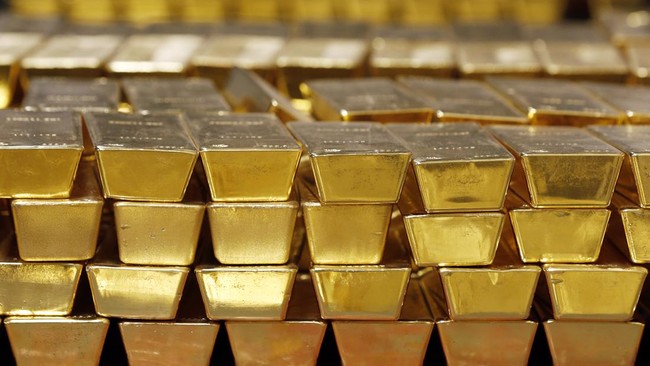
Jakarta, CNBC Indonesia - Gold remains a popular safe-haven investment instrument for people around the world. However, few know that history records a fantastic discovery in the country that once caused a global sensation.
It turns out, a gold reserve of up to 30,000 tons was found in the Banten region. Unfortunately, this ‘jackpot’ did not entirely benefit the Indonesian people, but was controlled by foreign parties during the colonial period.
The ‘Mountain of Gold’ in Southern Batavia
This story began in Cikotok, a region in southern Banten, about 200 km from Jakarta (formerly Batavia). Rumors about the gold content in this area had long been heard by the Dutch colonial government.
However, serious research only yielded results after a geologist named Oppenoorth conducted an in-depth survey. Despite having to clear dense forests and navigate extreme terrain, this effort eventually uncovered an extraordinary treasure.
In March 1928, the Sumatra-bode newspaper reported the astonishing discovery. “To date, 30,000 tons of gold have been found in Cikotok,” the report said, as quoted from historical archives.
Massive Exploitation by Foreign Parties
The discovery prompted the colonial government to act quickly. To extract the wealth, operational rights were given to a foreign company, NV Mijnbouw Maatschappij Zuid Bantam.
From here, gold mining was carried out on a large scale. The mining transportation routes were also accessed from Sukabumi. According to the de Indische Courant newspaper (July 25, 1939), the colonial government built a new access road from Rangkasbitung and Pelabuhan Ratu.
In addition, a factory with a capacity of 20 tons per day was also built. However, the factory could not accommodate all the gold extracted due to the sheer volume. Even during the work, the laborers often found gold of varying weights.
“During the work, gold of various weights was often found. The heaviest reached 126 grams,” wrote de Indische Courant (July 25, 1939).
In 1933, gold mining had yielded good results. There were 400 km2 of mining areas in Cikotok. Gold could be obtained simply by digging 50 meters. In fact, the government could obtain much more gold.
“The amount of gold revealed from the exploration totaled more than 61,000 tons of gold with a value of 3.68 billion guilders,” wrote de Locomotief (March 29, 1933).
However, the abundance of gold only benefited one party, namely the colonial government. They became increasingly wealthy. Meanwhile, the indigenous people did not receive any benefits or welfare from the gold mining, even though the colonial government had promised welfare for the indigenous people.
In short, the Cikotok gold source became the largest gold mine ever owned by the colonial government and continued to the Republic of Indonesia government. In the independence era, the Cikotok gold mine was taken over by NV Perusahaan Pembangunan Pertambangan and then continued by PT Aneka Tambang in 1974.
The history of the Cikotok gold mine ended in 2005 because the gold content was depleted. Even though it was depleted, the glory of the Cikotok gold mine was continued by a larger gold mine, namely Freeport in Papua.