
Sharia P2P Caught in the Whirlwind of Competition Cases: Notes on the KPPU Decision
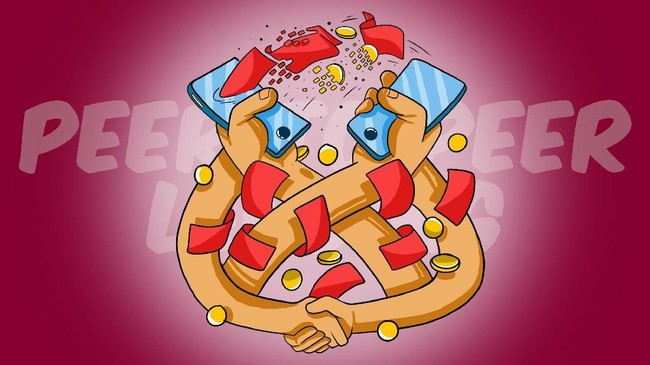
The decision by the Business Competition Supervisory Commission (KPPU) against 97 online loan providers in a monopoly case involving interest rate setting is like a spotlight suddenly directed at the fintech industry stage.
We are confronted with the reality of seeing more clearly something that has previously only felt vague: the tendency of business actors to walk side by side, not because of efficiency and innovation, but because of agreements on numbers. In legal terms, this is called horizontal price fixing, while in everyday practice, the public knows it as an interest cartel.
On paper, Law No. 5 of 1999 clearly states that agreements on price setting between competitors are prohibited and qualify as a serious violation. The KPPU’s guidelines on Article 5 of that law place price fixing as an act that does not need to prove impacts one by one because its nature is already considered to damage the market order.
However, in reality, cartels rarely appear with black-and-white written agreements. They emerge in the form of “coincidentally” similar numbers, association meetings with seemingly neutral themes, to the term “industry fair range” which is never regulated by law but treated as if normative.
Interestingly, among the 97 providers subject to the decision, there are also actors operating under a Sharia scheme. This fact serves as a reminder that Sharia P2P is not entirely outside the whirlpool of problems.
There has been an assumption that the Sharia label automatically distances actors from cartel practices, but the legal reality is not that simple. Indeed, in practice, Sharia transactions leave behind the interest system and switch to margins or returns linked to real sector activities.
However, this change does not automatically remove business actors from the competition law regime. As long as they operate in the same market and compete with each other, the principle of prohibiting collective price setting (price fixing) still applies, regardless of the terms or labels used.
It is important to emphasise that this situation cannot be read in black and white as an industry failure. Sharia P2P is still in a growth and adjustment phase. Many actors are still seeking a balance between Sharia compliance, business sustainability, and market dynamics. In this context, the emerging phenomenon is more appropriately read as a signal that the ecosystem needs refinement, not just enforcement.
The OJK’s regulations themselves affirm that “economic benefits” encompass all forms of rewards for the use of funds, without distinguishing the terms used. In Sharia P2P practice, this can be in the form of mudharabah profit-sharing, murabahah margins, or ijarah fees.
For the market, it all boils down to one thing: how much cost must be borne. When those numbers start moving in uniform patterns across platforms, the legal question that arises is no longer about Sharia or conventional, but whether there is coordination among business actors.
The complexity of the issue becomes apparent when regulator policies meet market behaviour. The OJK has set a maximum limit on economic benefits as a protection instrument. However, in practice, this limit is often read as a collective safe point.
Instead of being a fence, it potentially becomes a reference that tempts actors to cluster at the same range. Once the regulator mentions a maximum number, some actors feel it is easier to “huddle” at that limit rather than painstakingly formulating prices that truly reflect each one’s costs and risks.
This is where the risk of cartels enters through the back door. When almost all players place economic benefits in the same range, especially near the highest limit, the legal question is simple: is this purely the result of independent decisions, or is there coordination, whether explicit or merely mutual reading and adjustment?
The concept of tacit collusion explains a situation where, without any official agreement, actors consciously follow each other, resulting in an outcome similar to a cartel. There is no contract, but there is a pattern that is hard to explain solely with normal market logic.
The current regulatory framework for Sharia P2P has not fully functioned as a complete compass and still leaves significant gaps. The POJK on LPBBTI, as regulated in Financial Services Authority Regulation No. 40 of 2024 as an update to POJK No. 10/POJK.05/2022, has indeed regulated governance, consumer protection, and Sharia principle compliance. However, the relationship between Sharia principles and competition law has not been explicitly linked.
The absence of affirmation that the maximum economic benefit limit should not be used as a collective reference, and the lack of mandatory documentation for profit-sharing determination based on internal analysis, opens up grey areas that allow uniform practices to occur without appearing as violations. In such situations, the boundary between independent decisions and collective patterns becomes blurred, and that is where the risk of competition distortion begins to appear.
From a Sharia perspective, this issue does not stop at technical aspects. Sharia economics is built on values of justice, transparency, and welfare. When market structures move towards uniformity that limits consumer choices, what is tested is not only market mechanisms but also commitment to those values.
However, this is precisely where the strength of Sharia P2P lies. It has the ability to make corrections from within, by making Sharia principles a compass and boundary at the same time. This correction is not merely a response to regulatory pressure,