
Sharia financial entities in West Java urged to innovate
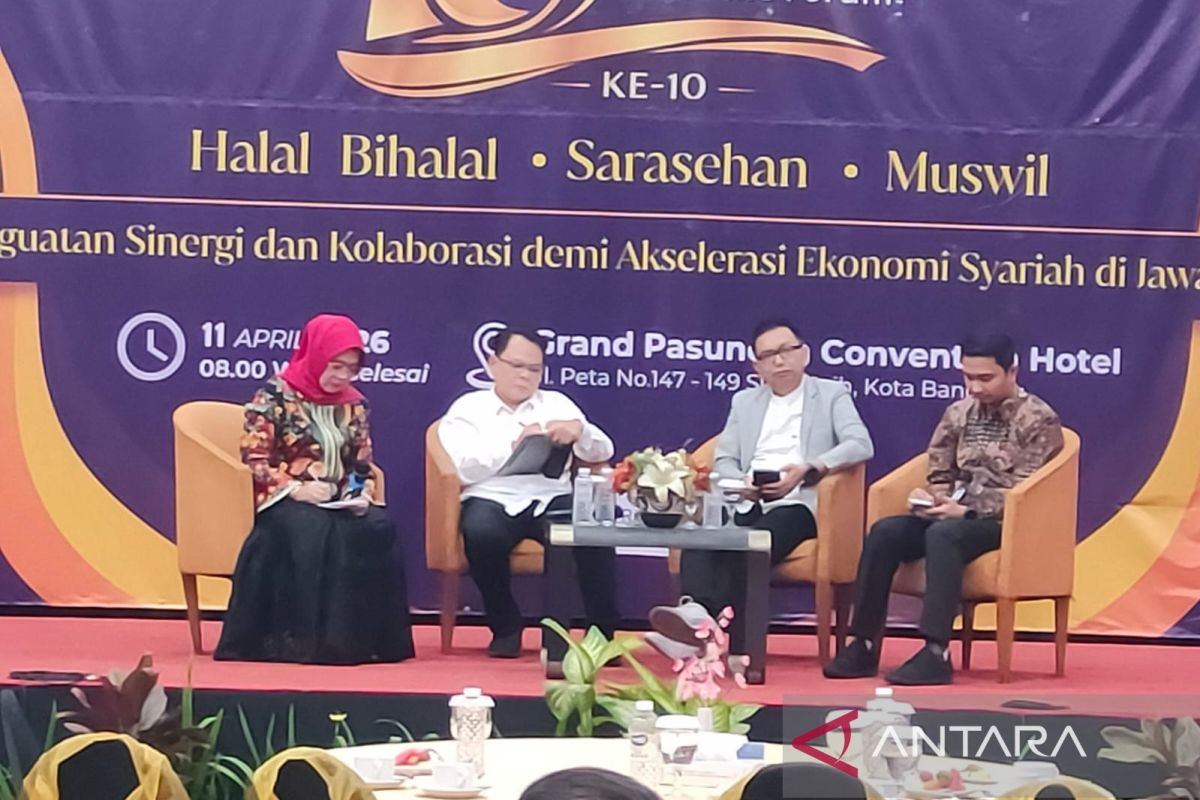
Bandung (ANTARA) - The Financial Services Authority (OJK) of West Java is urging the banking sector to innovate in meeting the needs of the community, thereby increasing sharia financial inclusion, particularly in that region.
“Through innovation in the products they offer, the needs of the residents can drive that inclusion,” said the Head of the Behavioural Supervision Division for Financial Services Business Actors of OJK West Java, Muhammad Ikhsan, at the 10th Jabar Islamic Economic Forum (JIEF) in Bandung on Saturday.
The innovations that can be implemented, Ikhsan explained, include expanding office networks that can reach the community widely and deeply in West Java.
“The main one is the office network. Office networks that can reach the remotest areas, which need to be improved going forward to increase inclusion,” he stated.
“Office networks. Then, those office networks need collaboration with IT so that they can meet needs; if we look at the community now, they want something simpler,” he said.
Another equally important innovation that can be undertaken by financial entities is emphasising the reduction of costs that the community must bear to enjoy sharia products, making them more competitive and attractive.
“Then, from the cost side, in sharia banking, the costs are still quite high compared to conventional ones. This is also a challenge, to lower the costs of services so that the reach becomes wider,” Ikhsan said.
“So, by introducing sharia finance to the community, it can also increase literacy as well as inclusion,” he added.
Previously, OJK West Java reported that the performance of the financial services sector (SJK) up to the first quarter of 2026 continued to show good resilience amid global and national economic dynamics.
Based on business activities, banking is still dominated by conventional types, with market shares of assets, third-party funds (DPK), and credit at 90.30 percent (Rp953 trillion), 89.40 percent (Rp671 trillion), and 88.58 percent (Rp922 trillion) respectively, while the remainder consists of sharia business types.
As of January 2026, the total assets of rural banks (BPR) and sharia rural banks (BPRS) in West Java reached Rp34.24 trillion, growing 4.92 percent year-on-year (YoY) by Rp1.60 trillion.
Third-party funds (DPK) of BPR and BPRS amounted to Rp22.98 trillion, growing 6.33 percent YoY (Rp1.37 trillion). Credit disbursements realised Rp24.69 trillion, growing 5.99 percent YoY (Rp1.40 trillion).
The gross NPL ratio of BPR and BPRS trended worse, from 11.86 percent in January 2025 to 13.63 percent in January 2026. Meanwhile, profits of BPR and BPRS experienced a decline in January 2026 to Rp4 billion, or a significant drop of 85.34 percent from Rp3 billion in January 2025 (down Rp2 billion).