
Sharia Assets Reach Rp3,100 Trillion, Sharia Inclusion Remains a Major Challenge
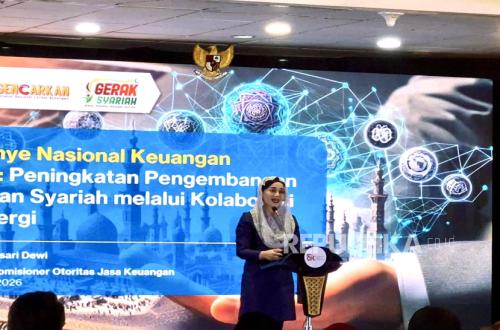
The national sharia financial industry has recorded positive growth, but expanding access for the public has not progressed as quickly as the rise in assets. The Financial Services Authority (OJK) notes that total sharia financial assets reached Rp3,100 trillion as of December 2025, growing 8.61% year-on-year (yoy).
This performance is supported by strengthening intermediation. Sharia banking financing grew 9.58% to Rp705 trillion, in line with a 10.14% increase in Third-Party Funds (DPK).
OJK Commissioner Chairman, Friderica Widyasari Dewi, stated that the sector’s stability remains well-maintained. “The stability of the sharia financial services sector is robust and resilient, as reflected in the continuous growth of intermediation performance,” she said at the Closing of the Gebyar Ramadan Sharia Finance 2026 in Jakarta on Thursday (2/4/2026).
By sector, sharia banking assets reached Rp1,067 trillion. Meanwhile, the sharia capital market dominated with a value of Rp1,800 trillion, followed by the sharia non-bank financial industry (IKNB) at Rp188 trillion. Sharia capital market capitalisation even surged to Rp8,900 trillion, or a 31.4% yoy growth.
However, behind this growth, the challenge of inclusion still looms. The utilisation rate of sharia financial services by the public is not yet commensurate with the level of understanding that has already been established.
An OJK survey shows that the sharia financial literacy index has reached around 43.4%, but the inclusion rate remains relatively low.
Head of OJK’s Executive for Behavioural Supervision of Financial Services Business Actors, Education, and Consumer Protection, Dicky Kartikoyono, assesses this gap as the main challenge. “Public understanding of sharia finance is already quite good, but encouraging them to enter this system remains a challenge,” he stated.
According to him, efforts to boost inclusion need to be strengthened through synergy and the utilisation of technology so that services become more easily accessible to the public. In agreement, representative of the Sharia Economic Community (MES), Ferry Juliantono, emphasised that future sharia finance development must be oriented towards real usage in society.
“We are no longer just building awareness, but must ensure that the public truly becomes active users of the sharia financial ecosystem,” he said.
Ferry added that strengthening this sector cannot be separated from the real economy, especially UMKM players and the halal industry. “Strengthening sharia finance cannot be separated from the real sector, such as UMKM and the halal industry,” he said.
According to him, integration with village cooperatives and local ecosystems can be a way to expand inclusion, while also encouraging UMKM products to enter wider markets.
With a Muslim population of 244.7 million people, the potential for sharia finance development is considered still very large. However, future challenges are no longer just about maintaining asset growth, but ensuring that these services are truly utilised by the wider public.