
Sexual Harassment of Students: How to Address It?
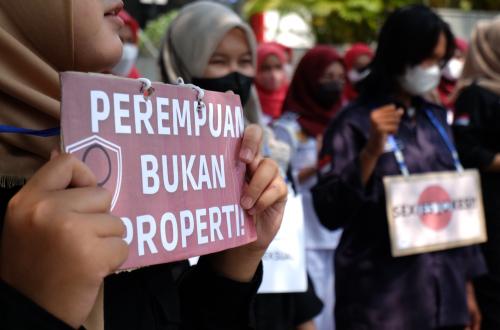
The world of higher education has been tarnished once again. This time, the incident and the perpetrators are no small matter. As many as 16 students from the University of Indonesia’s Faculty of Law are suspected of being involved in sexual harassment. A social media report revealed conversations with sexual harassment tones in the group chat of University of Indonesia Faculty of Law (FHUI) students. Currently, the case is being investigated by the campus authorities.
The Rector and the Dean of the Faculty of Law at UI have strongly condemned the sexual harassment actions allegedly committed by their students, deeming them degrading to human dignity and contrary to legal and academic ethical values. Any form of sexual harassment that occurs should indeed not be tolerated. All forms of verbal abuse that demean women, whether in the form of inappropriate content or writings that belittle women’s self-worth, must not be left unchecked.
Irony
The case of sexual harassment that occurred and is allegedly perpetrated by students from the University of Indonesia’s Faculty of Law is an irony. As a higher education institution that trains future law enforcers, the University of Indonesia Faculty of Law (FH UI) always holds a central position in discourses on justice. However, the good name of FH UI is quickly tarnished when news emerges regarding allegations of sexual harassment involving dozens of students. This is a hard slap to the integrity of the academic community.
The case that surfaced in early April 2026 is not merely an incident or a form of youthful mischief that got out of hand, but a reflection of moral (and criminal) violations occurring in Indonesia’s most prestigious university environment. The sexual harassment case at FH UI is certainly not the only case and not the first or last. Although various efforts have been made to prevent sexual harassment practices among students and lecturers, for some reason, such cases keep emerging from time to time.
Ideally, higher education should be an institution trusted and expected to be a breeding ground for intellectuals who care and have moral responsibility towards the fate of their fellow humans, especially vulnerable groups in society. However, cases at FH UI and other campuses show that the reality on the ground is often far from what is hoped for.
Data from the National Commission on Violence Against Women (Komnas Perempuan) indicates that sexual violence in higher education environments remains a worrying iceberg phenomenon. When a case comes to public attention, we often see slow responses or, worse, attempts to cover up the case to protect the “good name” of the higher education institution.
Instead of promptly responding and handling reported victims who become objects of sexual harassment, in practice, campuses often adopt a half-hearted attitude and even try to cover up the incidents for the sake of the institution’s reputation. According to Tjaden & Thoennes (2006), efforts such as improving investigation and prosecution skills, increasing access to mental health services, and developing prevention programmes in higher education could actually help address sexual violence. However, instead of helping, in various cases, sexual harassment incidents on campus are often swept under the rug or receive insufficient attention because they are not considered serious occurrences.
As stated by Katz (2016), a factor that often worsens sexual harassment in higher education is the social construction of masculinity. A campus culture that emphasises values like manhood and power can encourage male students to behave aggressively and disregard consent in sexual relations. Additionally, weaknesses in the legal system also exacerbate sexual harassment in higher education.
In the FH UI case, the University of Indonesia’s Task Force for the Prevention and Handling of Sexual Violence (Satgas PPKS) must certainly play a central role. With a victim-centred and “victim-perspective” approach, UI’s leadership has affirmed that they will not tolerate any violations. Coordination with authorities is a very likely option if the investigation finds criminal violations. This is the right step, considering that the Sexual Violence Crimes Law (UU TPKS) has provided a stronger legal framework than before. Without support from campus leaders’ concern, sexual harassment that haunts female students will undoubtedly continue to occur from time to time.
Handling Efforts
A campus is an educational institution that should be free from sexual harassment and not become a frightening place for its students. Transparency in handling cases, the courage to act against perpetrators without discrimination, and full support for survivors are absolute requirements to create a dignified educational environment.
As long as a campus does not dare to take a firm stance and continues to compromise with sexual violence perpetrators, that institution has essentially failed in carrying out its noble mission. We need moral courage to cleanse the campus from the threat of sexual violence. Kilmartin (2016) suggests that enhancing pro-social norms can help reduce sexual violence.
This includes developing understanding of gender equality and fostering a sense of responsibility among students to protect one another. Additionally, strengthening the legal system to provide protection for sexual violence victims and hold perpetrators accountable is also important.
To address the prevalence of sexual harassment on campuses, what is needed is not just socialisation and technical policies, but genuine concern as well as