
Setara Institute Releases 2025 Religious Freedom Report, Records 221 Violations
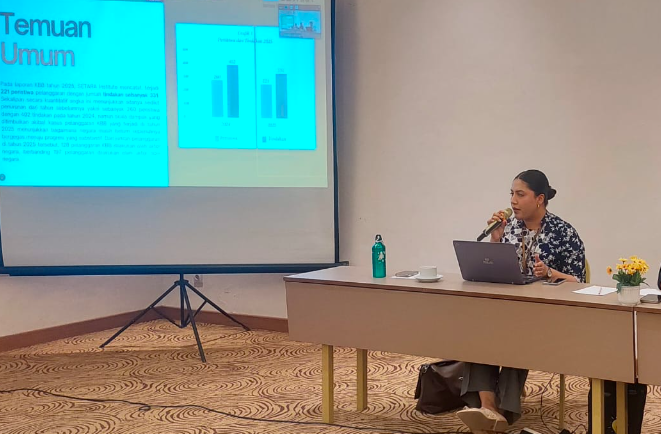
The Setara Institute has released its annual report on religious freedom and belief (KBB) in Indonesia throughout 2025. This report is significant as it constitutes the first comprehensive evaluation of religious rights protection performance under the administration of President Prabowo Subianto and Vice President Gibran Rakabuming Raka.
Religious Freedom/Belief Researcher at Setara Institute, Harkirtan Kaur, in her presentation demonstrated that the condition of KBB in Indonesia throughout 2025 continues to exhibit various unresolved issues. This situation is exacerbated by the existence of discriminatory regulations that validate intolerant groups in committing violation acts.
“In this 2025 KBB report, Setara Institute has compiled all incidents and KBB violation acts that occurred during the first year of President Prabowo-Gibran’s leadership,” said Harkirtan during her presentation in Menteng, Central Jakarta, on Tuesday (10 March).
Based on Setara Institute’s records, the same types of violations from previous years were found. This indicates that the 2025 KBB condition remains a serious problem and shows no significant improvement.
Violations Decline Slightly
In the 2025 KBB report, Setara Institute recorded 221 violation incidents with a total of 331 actions. This figure represents a slight decrease from the previous year, which saw 260 incidents with 402 actions in 2024.
“Although declining, the scale of impact resulting from KBB violation cases in 2025 demonstrates how the state has yet to fully accelerate towards substantive progression,” said Harkirtan.
Of the violations in 2025, 128 KBB violations were perpetrated by state actors, compared to 197 violations by non-state actors.
She noted that the number of incidents and actions showing little movement over the past five years reflects the weak commitment and actualisation of state support for protecting minority group rights.
One factor serving as a contextual trigger for the consistently high number of KBB violations over the past five years is the continued existence of discriminatory and intolerant regulations targeting minority groups in Indonesia.
Of the total 128 KBB violation actions by state actors throughout 2025, the majority originated from Local Government institutions with 71 actions, followed by the Police with 15 actions, each with 6 actions from the Military, Prosecutor’s Office, and Civil Police, as well as the Ministry of Religion with 5 actions.
Compared to the previous year, this number of violations showed a slight decrease. However, she noted that this quantitative reduction does not necessarily reflect an improvement in the quality of KBB protection.
Substantively, Harkirtan continued, there is visible concentration of violation patterns in acts of discrimination and prohibition or restriction of business activities based on religious identity. This pattern concentration reflects that the state, through its bureaucratic system, remains an actor in restrictive behaviour towards certain groups in society.
Besides state actors, KBB violations were also perpetrated by non-state actors in concerning numbers. Setara Institute found a shift in the largest number of non-state perpetrators from 2024, which was dominated by civic organisations (NGOs), to 2025 becoming citizen groups with 61 actions, followed by civic organisations with 51 actions, the Indonesian Ulema Council (MUI) with 23 actions, and each with 9 actions from religious figures, FKUB apparatus, and individuals.
One case exemplifying KBB violations by citizen groups is the case of destruction of a Christian house of worship that occurred in Padang Sarai, West Sumatra.
Meanwhile, Setara Institute’s Human Rights and Security Sector Reform Researcher, Ikhsan Yosarie, added that research on religious freedom and belief conditions (KBB) is conducted continuously by Setara Institute. This latest report is the 19th publication conducted consistently since 2007.