
Senator: Students Need Objective Understanding of Middle East Conflict
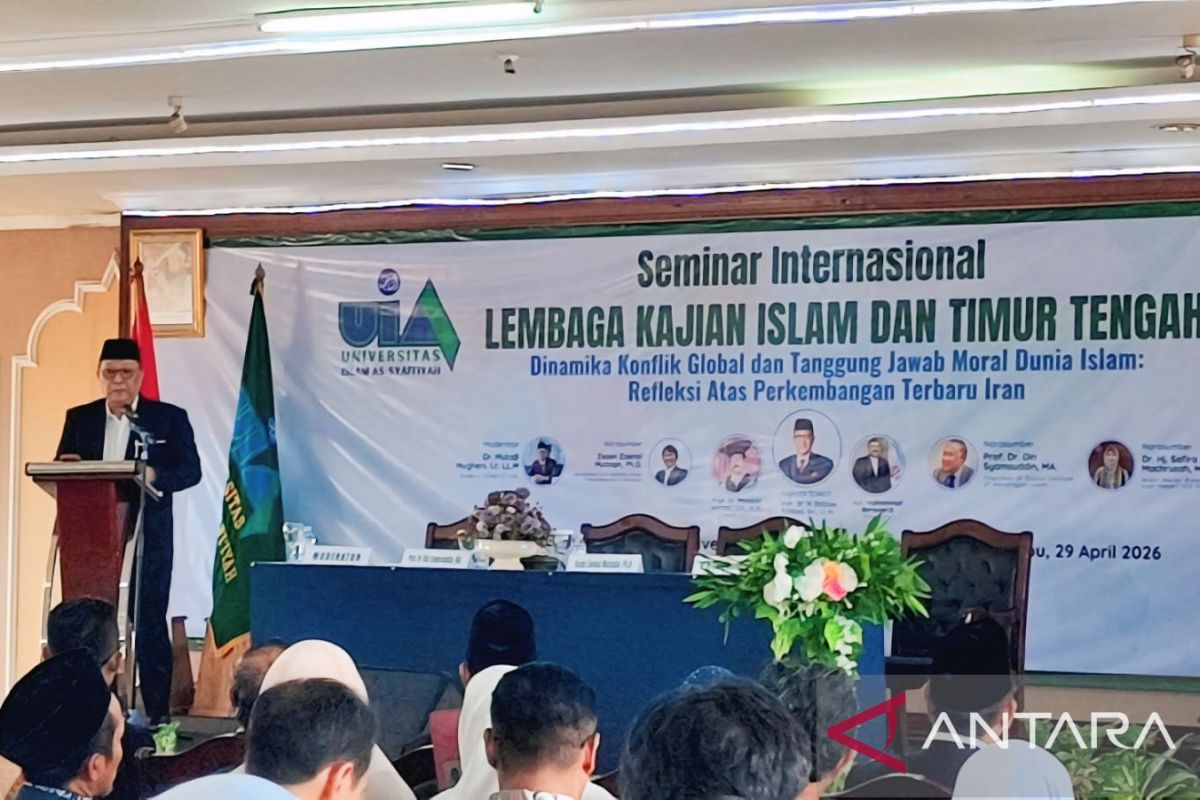
Jakarta (ANTARA) - Chairman of the As-Syafi’iyah Higher Education Foundation (YAPTA) and member of the Indonesian Regional Representative Council (DPD RI) Dailami Firdaus has emphasised the importance of providing an objective understanding to the younger generation regarding conflicts in the Middle East to prevent impacts on domestic stability.
“Indonesia as a nation with a Muslim-majority population must respond to global conflicts wisely and maintain national unity,” Dailami said at the International Seminar titled “Dynamics of Global Conflict and the Moral Responsibility of the Islamic World: Reflections on Recent Developments in Iran,” held at Universitas Islam As-Syafi’iyah (UIA) in East Jakarta on Wednesday.
He also stressed the importance of the government’s role in preventing the emergence of ideological conflicts within society through educational approaches and strengthening literacy.
“Who is responsible, and how should we, as an Indonesian nation with a Muslim majority, respond going forward to keep this nation intact? We must not allow ourselves to be further influenced, causing the conflict to shift or impact Indonesia,” said the DPD RI member from the DKI Jakarta electoral district.
According to him, the Islamic world is encouraged to emerge as a moral and ethical force in responding to escalating global conflicts, including tensions between Iran, the United States, and Israel, which are seen to have broad impacts on humanity and world stability.
“The Islamic world must present itself as a moral voice, an ethical force, and a guardian of universal humanitarian values. Remaining silent on injustice is not a stance taught in our faith,” he stated.
In the Indonesian context, he noted that the constitution affirms rejection of colonialism, making Indonesia’s role in promoting global peace crucial.
“Indonesia must consistently advocate for peace, be firm against sovereignty violations, and actively engage in global diplomacy. Indonesia also has the potential to serve as a bridge for world dialogue,” he said.
Furthermore, strengthening diplomacy, national resilience, and research-based policies are seen as key to ensuring Indonesia is not easily swayed by global dynamics.
Meanwhile, UIA Rector Masduki Ahmad stated that the roles of the government and educational institutions are vital in preventing the emergence of ideological conflicts within society.
Education and strengthening understanding, he said, are strategic steps to shape a rational younger generation that is not easily provoked.
“Ultimately, this war is actually related to efforts at hegemony by certain parties. Therefore, it is important for us to provide understanding and intelligence to students. You must be able to discern what is right and what is wrong,” he explained.
Masduki emphasised that his institution does not engage in practical politics to support specific parties, but rather focuses on educating the public, particularly students, based on constitutional values and national interests.
According to him, discussion forums and seminars are important spaces for enlightening students and academics.
“From this discussion, many pure and very good ideas emerge that can enlighten participants and encourage academics to speak out. We speak based on the constitution and for Indonesia’s interests,” said Masduki.
Meanwhile, Chairman of the Global Fulcrum of Wasatiyyat Islam, Prof Din Syamsuddin, presented an analysis of the conflict dynamics involving Iran and global powers.
He assessed that the conflicts are not only influenced by geopolitical factors but also by ideological and theological dimensions developing in the Middle East region.
“Like it or not, the epicentre of world civilisation has shifted, and the West is experiencing decline. The shift in the world’s economic centre of gravity to the Asia-Pacific region is one of the important factors in current global geopolitical dynamics,” he stated.
Din also highlighted Iran’s national resilience, which he deems strong due to a long tradition of education and intellectualism, as well as instilling spiritual values in the younger generation since the 1979 Iranian Revolution.
According to him, these historical, cultural, and educational factors shape a resilient national character in facing geopolitical pressures.
Therefore, Din emphasised the importance of viewing global conflicts comprehensively, not only from a political perspective but also historical, ideological, and civilisational ones.