
Seeking Signal in Remote Atadei for Academic Ability Test
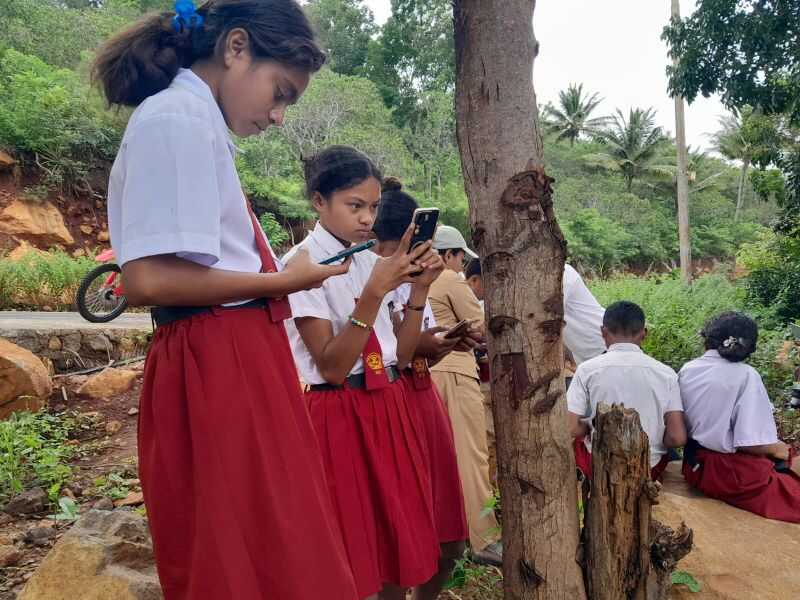
Amid formidable geographical challenges, eight sixth-form pupils from SD Inpres Atalojo, Atadei Subdistrict, Lembata Regency, East Nusa Tenggara, faced the start of their week on Monday, 2 March 2026, with a 2.5-kilometre walk on foot.
Wearing red-and-white uniforms, they travelled from Atalojo Village to Watulolo, the only location capable of capturing stable internet signal to participate in the online Academic Ability Test (TKA).
They did not walk alone. Three teachers accompanied them: Raimundus Ray Lein, who served as computer operator, alongside Roswita Sori Wutun and Beatrix Nogo Kolin. From early morning, the small group traversed a rocky route towards a location that, ironically, lay closer to cliffs and gardens than public facilities.
“Today’s test must proceed. Internet networks in the village do not permit it, so we can only access signal at Watulolo,” said Raimundus.
As students focused on completing the TKA questions, heavy rain suddenly fell. Strong winds forced them to halt the examination and rush for shelter. A simple shelter belonging to a resident became their refuge, though its facilities fell far short of standards suitable for educational activities.
The three teachers remained in the Watu Lolo area for several days ahead—throughout the TKA examination series. They ensured students obtained internet access and a safe environment, despite weather and terrain frequently presenting obstacles.
Signal limitations represent no novel story in Lembata Regency, one region in East Nusa Tenggara still struggling to pursue equitable digital infrastructure distribution.
According to the Head of the Lembata Regency Communications and Information Office, Petrus Demong, speaking to Media Indonesia on Monday, 2 March 2026, internet coverage in Lembata currently reaches only 70 per cent—despite network availability standing at 100 per cent.
“Still 30 villages receive only 3G service. The rest have 4G. The challenge lies in frequency speed, although transmission towers have been constructed across all subdistricts. Even base stations have been prepared, yet remain suboptimal,” explained Petrus.
In Atadei Subdistrict, internet access depends upon a shared tower standing in Kalikasa Village. That tower operates under management by several service providers, including XL and Telkomsel. However, frequency problems remain the primary obstacle.
Petrus added that this condition could actually be resolved through satellite internet services such as Starlink, yet subscription costs remain relatively burdensome for both regional budgets and communities.
Amid all infrastructure shortcomings, the determination of pupils at Atalojo did not waver. Long journeys, uncertain weather, and difficult signal proved no reason to surrender. Under guidance from tireless teachers, these children continue fighting to grasp their futures—despite confronting hills, rain, and 2.5-kilometre distances each day.
This story serves as a reminder that educational digitalisation concerns not merely delivering online examinations, but rather guaranteeing every child in Indonesia possesses equitable access.
In remote Atadei, the struggle continues, yet the determination of students and teachers demonstrates that hope remains alight.