
Seeking LPG Import Alternatives: Two Solutions Prepared
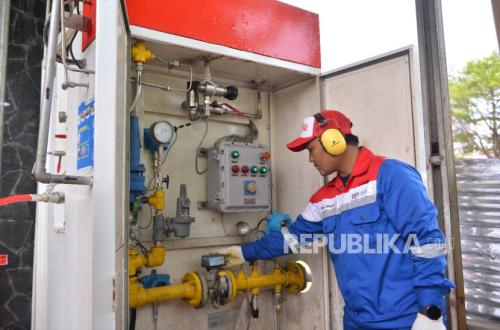
The Badan Pengatur Hilir Minyak dan Gas Bumi (BPH Migas) is encouraging the optimisation of compressed natural gas (CNG) utilisation and the acceleration of mini liquefied natural gas (LNG) development as alternative household energy sources. BPH Migas Committee Member Fathul Nugroho stated in Jakarta on Saturday (9/5/2026) that these steps will strengthen national energy resilience while reducing reliance on liquefied petroleum gas (LPG) imports.
According to him, optimising CNG mother stations and building mini LNG infrastructure will provide more energy options for the public beyond LPG.
“So, it’s not limited to LPG alone, but there are choices to use CNG and LNG. These energy options can also improve the effectiveness of gas distribution and support the government’s targets in converting to safer, cleaner, and more efficient energy,” said Fathul.
Furthermore, Fathul noted that current household energy needs are still dominated by subsidised LPG, which burdens the state budget and drives high import dependency. Currently, Indonesia’s LPG imports reach 81% of total public needs.
The development of CNG and LNG for households also aligns with President Prabowo Subianto’s Asta Cita, particularly in promoting national energy self-sufficiency.
“In addition, Minister of Energy and Mineral Resources Bahlil Lahadalia has stated that CNG is a gas different from LPG but serves a similar function as an energy source. Meanwhile, CNG utilisation is already starting to be used in the commercial sector, such as hotels and restaurants,” he said.
In the National Medium-Term Development Plan (RPJMN) 2025-2029, the government targets the construction of natural gas networks for households to reach 350,000 household connections (SR) by 2029.
To achieve this target, BPH Migas assesses that regulatory acceleration related to CNG mother stations and mini LNG terminals is needed so that investments can enter more quickly.
Additionally, the public-private partnership (KPBU) financing model is also considered important to support infrastructure development, especially in eastern Indonesia, which faces geographical challenges.
“To expand the reach of jargas (natural gas networks) using CNG, it can be done through the conversion of gas fuel filling stations (SPBG) into mother stations. Whereas for non-pipeline jargas distribution, mini LNG can be used,” he said.
“Thus, the abundant natural gas potential can soon be felt for its benefits to realise national energy independence,” he added.