
Seeking Blessings in a Bumper Rice Harvest
By: Entang Sastraatmadja, Member of the Expert Council of DPN HKTI
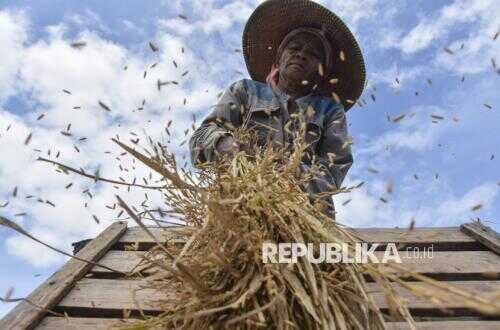
REPUBLIKA.CO.ID, JAKARTA – From various experiences, the benefits of a bountiful harvest can be understood as a result that brings abundance and prosperity to many people.
Many parties benefit from a bountiful harvest. Whether it is related to improving the welfare and lives of farmers; whether it is related to improving government policies or the interests of other parties.
In detail, for farmers, the benefits are abundant harvests, good selling prices, and increased family welfare.
For the government, food security is guaranteed, inflation is controlled, and the image is improved because it has succeeded in improving the welfare of the people. For traders, increased turnover and profits due to abundant supplies at competitive prices.
For academics, there are opportunities for research and development of knowledge about agriculture and economics. For the mass media, there is an increase in positive news coverage about Indonesian agriculture and economics.
In addition, there is an increase in income from advertising and promotion of agricultural products.
Unfortunately, to date, these benefits have not been fully realised, although some progress has been made. The Indonesian government has made several efforts to increase food production, such as simultaneous harvests in 14 provinces and 157 districts/cities.
This shows the government’s commitment to increasing food production and achieving rice self-sufficiency. Some examples of progress that have been achieved include, first, increased productivity.
The use of modern technology and superior varieties has increased yields per hectare. Second, strengthening infrastructure. The construction of better storage and distribution warehouses helps reduce post-harvest losses.
Third, government support. The government has provided subsidies and incentives to farmers to increase production. However, it cannot be denied that there are still several challenges that must be faced.
The main challenges that need to be addressed include climate change. Extreme weather disturbances (floods, droughts) affect crop yields. Furthermore, inadequate infrastructure. Damaged roads, insufficient irrigation, and inadequate storage facilities.
Then, technology. Farmers still use many traditional methods and have limited access to modern technology. Then, production costs. High input prices (fertilizers, seeds, tools) reduce farmers’ profits. In addition, the quality of human resources. Lack of knowledge and skills of farmers in modern agriculture.
The rice harvest in Indonesia is expected to begin in February 2026, with a projected increase in production of around 5-10 percent compared to the previous period.
At the beginning of 2026, President Prabowo Subianto led the rice harvest in Karawang, West Java, as part of the government’s efforts to achieve food self-sufficiency.
This year’s harvest is expected to have an impact on increasing national rice production; increasing farmers’ income; increasing national food security; and improving the welfare of the community.
It is also important to note that this year’s harvest is the first test to preserve the rice self-sufficiency that has been achieved as of 31 December 2025.
Rice self-sufficiency in 2025 is not the first time this nation has achieved it. Several times we have been able to achieve complete rice self-sufficiency, along with many praises and prestigious international awards.
The Food and Agriculture Organization (FAO) is known as an institution that often gives awards whenever this nation achieves achievements in the field of rice. Sadly, in terms of quality, the rice self-sufficiency we have achieved is generally of a “on trend” nature.
Or it is often said to be temporary rice self-sufficiency. If the climate and weather favour farmers, rice production will soar, but if not, we will have to open the rice import tap again.
Considering the picture and journey of rice self-sufficiency in this country, it is understandable that when discussing rice self-sufficiency in 2025, we need to be more open in managing true rice self-sufficiency.
We want to provide evidence that the announced rice self-sufficiency is not just to pursue short-term interests, but must last throughout time. The key to rice self-sufficiency is abundant rice production.
Without an increase in production, there will be no rice self-sufficiency. That is why the political will of President Prabowo’s government to achieve sustainable rice self-sufficiency is not easy to prove.
The problem could become more complicated when there is a view that “Efforts to maintain or preserve rice self-sufficiency tend to be more difficult than achieving it”.
It is even more challenging when the government also wants to achieve food self-sufficiency as soon as possible. Experience has shown that achieving self-sufficiency in just one type of food is already difficult, let alone various types of food.
But what can we do. All of this is a struggle that requires hard work to achieve. All components of the nation are important to synergize and collaborate. Let us unite all stakeholders in the rice industry.
In any case, the honour and responsibility as a nation demands that we contribute our best for the nation and our beloved country.