
Sectoral Ego Hinders Energy Transition on Agricultural Land
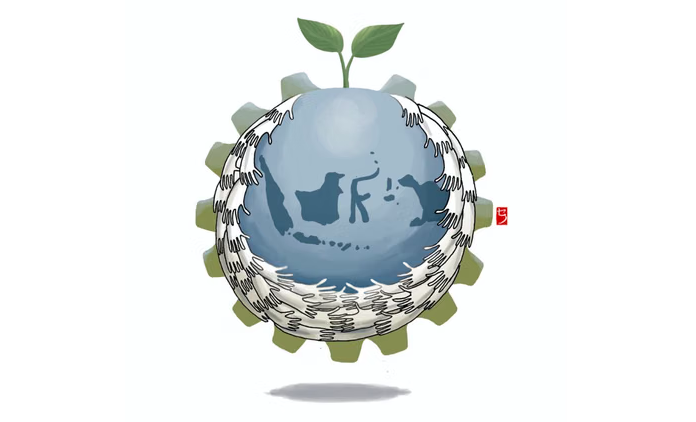
Friction in land utilisation between renewable energy projects and productive agricultural areas in Indonesia is seen not merely as a technical obstacle, but as a reflection of sectoral ego in regulations that operate independently. This triggers investment uncertainty while threatening national food security.
Legal expert Andrie Taruna reveals that this pattern of conflict recurs every time clean energy projects, such as Solar Power Plants (PLTS), intersect with Protected Paddy Fields (LSD) or Sustainable Food Agriculture Land (LP2B). According to him, the food sector is safeguarded by restrictive and multi-layered legal instruments, while the energy sector is driven by progressive and urgent transition targets.
“The source is the way the state regulates these two sectors in two different rhythms and logics that are not yet interconnected,” Andrie stated in a written remark on Monday (30/3).
Andrie explains that the characteristics of PLTS projects, which require flat, open land near the electricity grid, often directly overlap with the most valuable agricultural zones. This lack of synchronisation results in energy projects becoming trapped in “legal space that is tightly locked” by paddy field protection rules.
Furthermore, this doctoral student from Brawijaya University highlights that Indonesia’s spatial planning system is still trapped in a single-use land paradigm, which rigidly separates energy and agriculture functions. Yet, current development needs are highly complex and overlapping in the same space.
“If the legal system continues to force space to work in the old way, conflicts will keep recurring even if the government repeatedly changes targets and updates regulations,” Andrie emphasised.
He assesses that the current regulatory rigidity is not caused by the abundance of rules, but by the inability of those rules to function as an integrated system. The impact is swelling project costs due to systemic risks, from permitting obstacles to social resistance from village communities who view paddy fields as symbols of livelihood security.
As a solution, Andrie urges policy design reforms encompassing three strategic steps. These include synchronising all national strategic maps, such as LSD, electricity networks, energy potential, and others, into one decision-making system.
Additionally, opening up more adaptive space categories, such as integrative zones for dual use, could be implemented. This also includes certainty in early permitting pathways for projects adopting integrative designs.
Therefore, the Legal Director of Gema Aset Solusindo concludes that regulatory synchronisation is the key to national economic efficiency. Without a legal architecture capable of uniting energy and food interests, the acceleration of energy transition will continue to be hindered while food land protection will always feel threatened.
“The energy-food conflict is not fate. It is a product of a system that has not yet been aligned. And because it arises from design, it can only be resolved with better design,” he concluded.