
Secret Message Leaked! US Admits Pressure in Muslim World, Indonesia in Spotlight
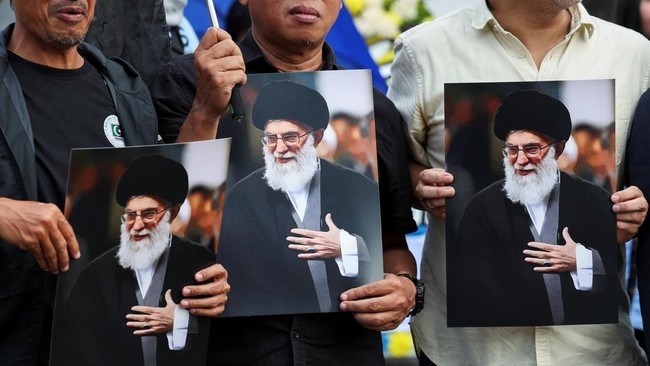
Jakarta, CNBC Indonesia - The global position of the United States in various countries, including Indonesia. Leaked internal diplomatic documents show serious concerns that Washington’s image is increasingly under pressure, especially in the Muslim world, as pro-Iran narratives become more dominant in public spaces.
Several US State Department diplomatic cables obtained by Politico reveal how this war is impacting US security relations in three different countries: Bahrain, Azerbaijan, and Indonesia. In a report sent on Wednesday (15/4/2026), US diplomats described a worrying situation in which the US faces widespread public opinion pressure.
The diplomats assessed that pro-Iran actors are highly active in exploiting digital spaces. They use various methods to shape opinions, from propaganda to communication strategies deemed more agile than Washington’s.
In Azerbaijan, relations that had previously improved are now described as “stagnant” and even potentially weakening. Meanwhile, in Bahrain, the government faces public questions about the US commitment to protecting its allies from Iranian attacks.
However, the greatest attention is focused on Indonesia. In a diplomatic cable from the US Embassy in Jakarta, diplomats warn that anti-American sentiment could increase and directly impact bilateral relations.
The cable states that the embassy needs more room to respond to negative narratives, with “the freedom to use flexible, rapid, and proactive social media to address challenges in making an impact in the crowded digital space,” according to the secret message.
However, the US diplomats admit that their room for manoeuvre is limited. They are reportedly prohibited from creating original content related to the Iran war and are only allowed to repost official messages from the White House or State Department.
This situation has even made some diplomats reluctant to speak out. “Representatives are very cautious in choosing topics and how they convey something,” said one diplomat who requested anonymity.
In contrast, Iran is seen as aggressively exploiting various digital platforms. They use bots, memes, and social networks to spread messages that weaken the US image. Even Iranian diplomats are actively building sympathy through religious, cultural, and social networks.
US State Department spokesperson Tommy Pigott defended Washington’s policy.
“President Trump’s actions make the United States, future generations, and the entire world safer by preventing the Iranian regime from acquiring nuclear weapons. That is the reality, and the entire administration is aligned in that effort,” he said.
In Indonesia, Iran is said to be running a significant influence operation. Through traditional media and platforms like Telegram and Facebook, Tehran raises issues of Muslim solidarity and anti-colonial sentiment, portraying the US and Israel as imperialist powers.
According to US diplomats, this campaign is effective. Content from the Iranian Embassy is now generating more interactions than before, including thousands of views and positive comments.
The diplomatic cable warns that if the conflict continues, public pressure could limit the room for President Prabowo Subianto to maintain security cooperation with the US.
“The most dangerous short-term risk is not that Iran’s message will be fully believed, but that it will reinforce existing anti-American sentiment to the point of limiting President Prabowo’s political space to continue moving forward with regional security cooperation,” the cable states.
Meanwhile, Indonesia has previously taken several steps to strengthen relations with Washington, including offering contributions to Gaza security and establishing defence cooperation.
However, Politico writes, domestic political pressure could change that direction. Even the Iranian ambassador is said to have called for Indonesia to withdraw from the US-initiated Board of Peace.
Although there is no indication that the government will take such a step, discussions on that cooperation were reportedly postponed.
In the midst of this situation, the US Embassy in Jakarta is requesting additional support to strengthen public diplomacy. “Representatives welcome additional public diplomacy initiatives that promote US policy in the Middle East and counter anti-American messages to reach the Muslim-majority audience in the current situation,” the cable states.
Bahrain and Azerbaijan
In Bahrain, a close US ally in the Middle East, public perceptions are also beginning to shift. A cable from Manama mentions the emergence of the view that Washington is more focused on protecting Israel than its Gulf allies.
Pro-Iran narratives even claim that the US military presence endangers the country. One viral post reads: “Why are US troops stationed in hotels among civilians? Does America, which has abandoned the Gulf region for Israel’s security and Prime Minister Benjamin Netanyahu’s goals, deserve to put the people of Bahrain at risk?”
The diplomats assess that weak US communication is one of the causes. They warn that without a strong counter-narrative, Iranian propaganda could erode public trust in US commitments.
In Azerbaijan, changes in sentiment are also evident. After previously improved relations following the peace meeting between Azerbaijan and Armenia, local media are now becoming more critical of the US.
“Most local media blame the United States and Israel for starting the conflict and for allegedly having no clear strategy or goals to end it,” the cable states.
Nevertheless, anti-US sentiment in Azerbaijan has not fully shifted to support for Iran. The public in that country remains sceptical of Tehran.