
Sea of Humans and Vehicles at Gilimanuk as Ferries Operate at Lightning Speed
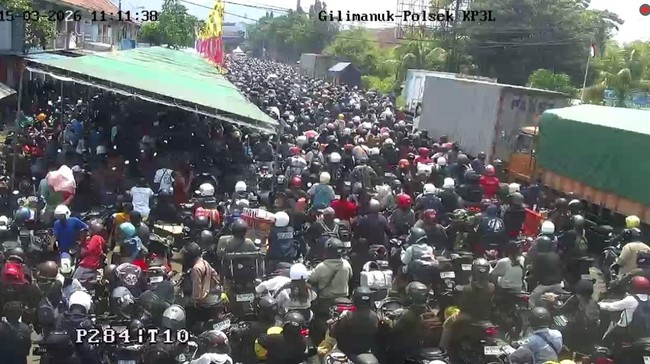
Severe congestion has developed on routes leading to Gilimanuk Ferry Terminal in Bali, with vehicle queues stretching for tens of kilometres as volumes surge towards the crossing to Java.
Transport Minister Dudy Purwagandhi stated that the government is implementing various measures to alleviate the congestion affecting the area. These efforts involve intensive coordination in the field by Bali’s Land Transportation Management Agency (BPTD) alongside relevant stakeholders.
“The Transport Ministry continues to endeavour to ensure all transport services operate safely, smoothly, and in a controlled manner. We are also promoting the acceleration of various operational measures in the field to speed up the resolution of vehicle and passenger congestion at Gilimanuk, so that public mobility remains well served. To improve coordination effectiveness, I have instructed the Deputy Transport Minister and Director General of Land Transport to go directly to Gilimanuk,” Dudy stated on Monday, 16 March 2026.
Currently, vehicle queues remain dominated by motorcycles and private cars seeking to cross to Ketapang Port in East Java. This surge in vehicles has caused significant congestion on routes to the port.
To increase ferry capacity, the Transport Ministry has expanded the number of vessels operating on this route. The fleet now comprises 35 ferries serving the Ketapang-Gilimanuk crossing, up from the previous 28.
The vessels consist of 19 ferries berthed at moveable bridge (MB) terminals, 11 ferries operating at landing craft machine (LCM) terminals, and four additional vessels deployed to expand vehicle and passenger carrying capacity. The entire fleet operates on an eight-trip service schedule.
Beyond expanding the fleet, the government has implemented several operational measures to accelerate vehicle flow. One such measure is the arrive-unload-depart (TBB) scheme to enable faster ferry rotation.
Vehicle flow management on land has also been tightened. Buffer zones at Gilimanuk Port’s cargo terminal have been activated to accommodate vehicles before entering the port, whilst the Cekik checkpoint’s function has been optimised as a vehicle control point ahead of the crossing area.
“Vehicle traffic management has also been strengthened through the operation of buffer zones at Gilimanuk Port’s cargo terminal and the optimisation of the Cekik checkpoint as a vehicle control point before entering the port area,” Dudy added.
Regarding weather conditions, the government has confirmed that the Bali Strait remains safe for maritime operations. Visibility in the strait reaches approximately 10 kilometres, with ocean currents flowing northward at approximately 2.5 knots. These conditions are deemed suitable to support ferry operations on the Ketapang-Gilimanuk route.