
Sea Kings' Battle: The US Once Mocked China, Now It's Breaking Out in a Cold Sweat
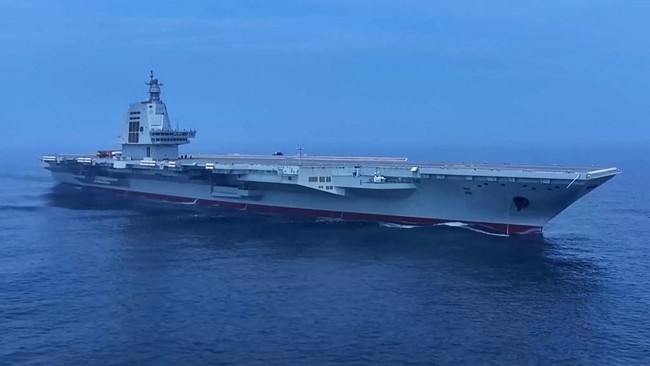
China is increasingly intensifying its efforts to build naval military strength. This policy is beginning to make the United States (US) anxious.
One of the most anticipated assets in China’s fleet by the world is the Type 004. This aircraft carrier is believed to have already made the US, the king of the seas, fearful even before its launch.
The Type 004 does not yet have an official operational schedule or sea trials announced to the public. To date, the ship is still in the early construction phase at the Dalian shipyard since 2024.
The Type 004 aircraft carrier will be China’s nuclear-powered supercarrier. This represents a major leap that will place Beijing in an exclusive club currently occupied only by the US Navy and France.
Once the Type 004 begins operating, China will join the small group of nations operating nuclear-powered aircraft carriers with nearly unlimited range, limited only by the crew’s sustenance needs.
The Chinese Navy, or People’s Liberation Army Navy (PLAN), has more ships than any other navy in the world.
The construction of its aircraft carriers is also accelerating. Over the past few decades, China’s aircraft carrier development has aimed to give Beijing strong power projection capabilities in its surrounding regions.
China currently has three main aircraft carriers: Liaoning, which is the first converted from an ex-Soviet carrier and initially used for training; Shandong, as the first fully domestically built carrier; and Fujian, the most modern carrier with electromagnetic catapult technology for aircraft launches.
The PLAN began operating aircraft carriers in the 1990s after purchasing Varyag, an unfinished ex-Soviet carrier sold after the end of the Cold War and defence spending cuts.
After major renovations, the ship began operating in 2012 under the name Liaoning. This was the PLAN’s first modern carrier, but its role was mainly to study carrier design and operations, not as a primary combat vessel.
After Liaoning entered service, the PLAN built its first fully domestically produced carrier, Shandong, which began operating in 2019. Although it appears similar to Liaoning, Shandong features several design improvements.
Now, China’s third carrier, Fujian, is undergoing sea trials after beginning operations in 2022. Fujian is more advanced than its predecessors and is equipped with an electromagnetic catapult launch system, similar to the upcoming US Navy Ford-class carriers.
This system allows the launch of heavier aircraft at a higher rate and improves carrier operational efficiency.
Despite being more advanced, the PLAN’s carrier ambitions do not stop there. China’s latest carrier, temporarily known as Type 004, will be an entirely new type.
Even in Submarines, the US is Starting to Worry
The sea is the last domain where America still holds a clear military advantage over China.
In the increasingly transparent modern warfare world due to sensors.
“Being underwater is important because it’s one of the last places to hide,” said Thomas Shugart, a former submariner. However, America’s underwater dominance is also beginning to be threatened, quoted from The Economist.
US submarine crews once dismissed Chinese submarines as too noisy. Now, that mockery has turned into concern.
Chinese President Xi Jinping is building the world’s largest navy and the fastest-growing nuclear arsenal while strengthening his submarine fleet.
Currently, China’s fleet mostly uses conventionally powered submarines, which are limited in speed and range.
However, over the next decade, US intelligence estimates that new-generation nuclear submarines will dominate, challenging US supremacy in the Pacific, Indian Ocean, and possibly the Atlantic.
US military sources say China is developing much quieter submarines with Russian technology assistance. Vice Admiral Richard Seif described the new Chinese ships as very formidable and challenging US underwater dominance.
The head of US naval intelligence, Rear Admiral Michael Brookes, estimates that China will have 70 submarines next year and 80 by 2035, including around 40 nuclear ones, more than previous estimates. In comparison, the US has 67 nuclear submarines.
The AUKUS Race and Allies
To maintain superiority, the US formed AUKUS with Australia and the UK for nuclear submarine technology transfer. However, the new ships will not be ready until the 2040s. Meanwhile, the US plans to sell 3-5 Virginia-class submarines to Australia in the 2030s.
The US is also collaborating with South Korea to build hunter submarines, while Japan has shown interest.
However, a major problem arises: the US industrial capacity cannot meet production targets. The US can only produce about 1.1-1.2 Virginia submarines per year, far below the needed 2.33 units per year.
The US submarine fleet has also shrunk from around 70 to 67, and could decline further before increasing again in the mid-century. Even a third of the submarines are inactive due to long maintenance times. Some are even decommissioned.
The United Kingdom faces similar issues in its submarine industry, which could threaten the AUKUS project.
China’s Challenges
On the other hand, China is estimated to be able to produce two attack submarines and one ballistic nuclear submarine per year since 2024 thanks to new facilities. Nuclear submarines are expensive due to special steel requirements, precision welding, and complex stability systems.
Nuclear submarines are revolutionary. They can operate for decades without refuelling. USS Nautilus pad