
Scientists Warn of Earthquake Risks as the Moon Continues to Shrink
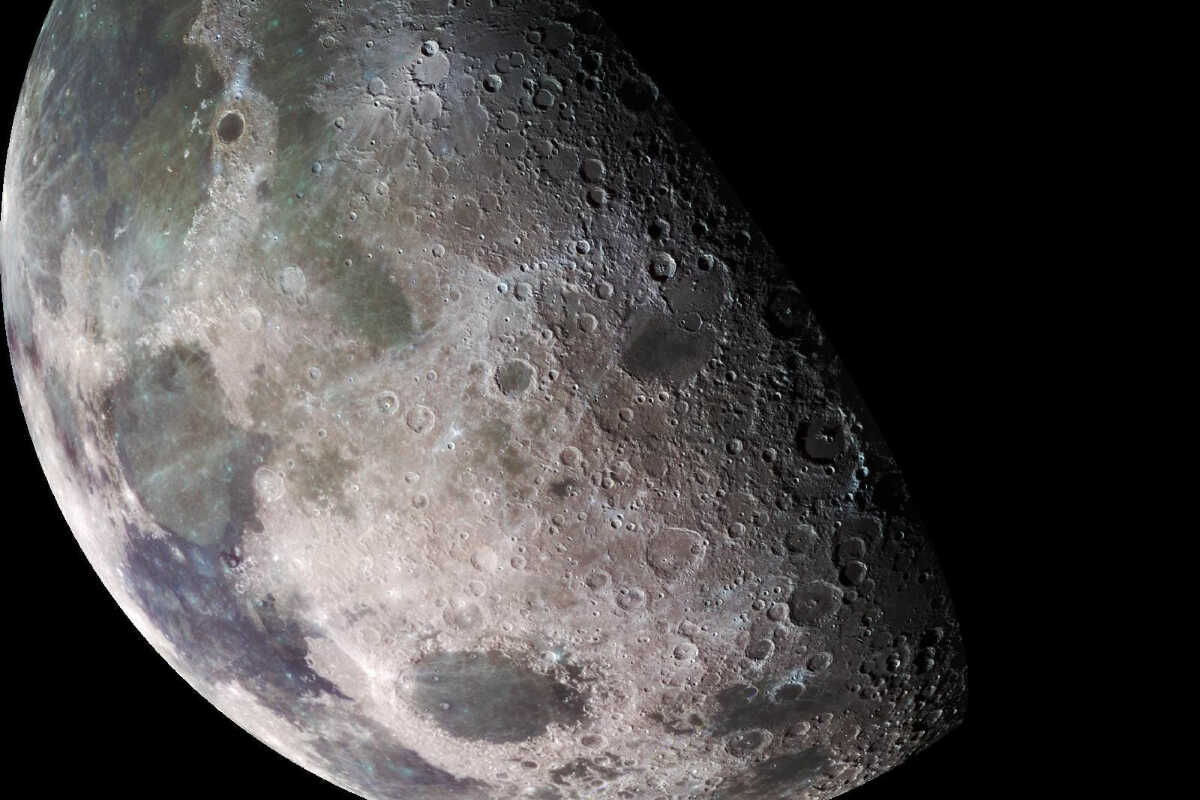
For a long time, the Moon has often been considered a geologically dead celestial body, but recent research reveals surprising facts. Scientists from the Center for Earth and Planetary Studies at the National Air and Space Museum have just released the first global map documenting thousands of small geological features called Small Mare Ridges (SMR).
This finding, published in The Planetary Science Journal, confirms that the Moon is actively continuing to shrink, a process that triggers moonquakes in areas previously considered stable.
Unlike Earth, which has tectonic plates that collide or move apart, the Moon has only one continuous crust. Tectonic stress on the Moon occurs because the Moon’s interior or core slowly cools.
This cooling process causes the Moon’s surface to wrinkle, similar to how a grape turns into a raisin, creating tremendous pressure on its crust. This pressure then forms giant wrinkles or faults on the surface.
The research, led by Cole Nypaver and Tom Watters, successfully identified 1,114 new segments of SMRs that were previously unrecognized in the maria, the dark plains of the Moon visible from Earth. With this finding, the total number of recorded wrinkles now reaches 2,634.
Analysis shows that the average age of these wrinkles is about 124 million years, which is very young on a geological timescale. The fact that these features are widespread indicates that tectonic activity due to the shrinking of the Moon occurs globally, not just in a specific area.
The implications of this finding are crucial for the safety of future space missions, such as NASA’s Artemis program. Because these wrinkles are formed through active faults, scientists warn that moonquakes can occur wherever these features are found.
Earthquakes on the Moon can last much longer than on Earth due to its dry and rigid structure, so the vibrations can be very damaging to the infrastructure of a base or the safety of astronauts living there.
Understanding the locations of these active areas provides a new perspective for scientists to determine the safest landing sites. With a complete map of the shrinking and seismic activity, lunar exploration missions are expected to avoid the risk of tectonic disasters.
Source: Science Alert
The Moon is slowly moving away from Earth at about 3.8 cm per year. This phenomenon causes the Earth’s rotation to slow down and the length of a day to increase, although the change is very slow.
This research was conducted by a team of scientists led by Prof. Steve Brusatte from the University of Edinburgh and Dr. Gregor Hartmann from Helmholtz-Zentrum, Germany.
This finding was published in the scientific journal Nature in a paper titled Soft photonic skins with dynamic texture and color control.
The name of an Indonesian priest and scientist, Bayurisanto, has been officially assigned by the International Astronomical Union as the name of an asteroid.
Kimberlite is a type of ultrabasic igneous rock that originates from depths of more than 150 kilometers below the Earth’s surface, specifically in the mantle.
NASA was forced to withdraw the SLS rocket for the Artemis II mission from the launch pad due to a helium flow problem. The launch to the moon is now scheduled for no earlier than April.
NASA has released a report of findings from the Boeing CST-100 Starliner Crewed Flight Test Investigation Team.
The Curiosity rover has discovered a unique geological formation in the shape of a “spider web” on Mars. This boxwork phenomenon is believed to have formed from ancient water activity.
February 2026 will feature a rare planetary parade. Mercury, Venus, Neptune, Saturn, Uranus, and Jupiter will be visible together, peaking on February 28.
NASA, through the Chandra Observatory and the James Webb Telescope, has discovered an ancient protocluster galaxy, JADES-ID1, which formed very early, challenging theories of the formation of the structure of the universe.
Copyright @ 2026 Media Group - mediaindonesia. All Rights Reserved