
Scientists Finally Discover Why T-Rex Had Small Arms Despite Large Head
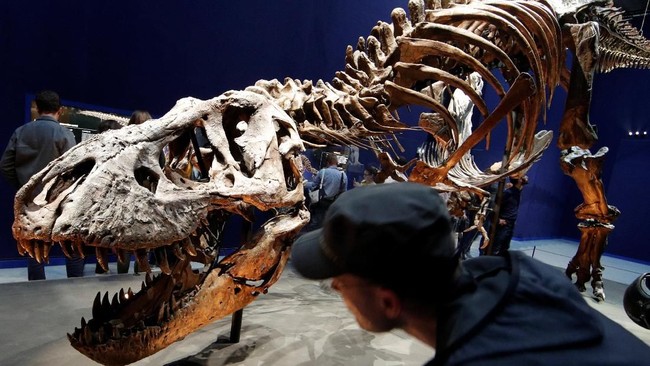
The mystery of the tiny arms on the legendary predator Tyrannosaurus rex (T-Rex) has finally been solved. A recent study reveals that the miniature hands of the T-Rex likely resulted from significant shifts in hunting strategies employed by the giant carnivorous dinosaur millions of years ago. Research led by scientists from University College London (UCL) and the University of Cambridge found that ancient giant predators gradually abandoned the use of claws, instead relying on powerful skulls and lethal bites to subdue prey. Published in the journal Proceedings of the Royal Society B, the study analysed 82 theropod species—two-legged dinosaurs mostly carnivorous. The researchers discovered that front limb reduction occurred separately in at least five dinosaur groups, including tyrannosauridae, the family of T-Rex. Lead author Charlie Roger Scherer explained that the small arms were not merely a side effect of the dinosaurs’ increasing size. ‘We wanted to understand what drove this change and found a strong link between short arms and large, powerful skulls. The head took over the role of the arms as a weapon. This is a ’use it or lose it’ scenario where arms became less useful and shrank over time,’ he said, citing ScienceDaily on Thursday, 21 May 2026. The study suggests the shift was triggered by the emergence of giant herbivores like sauropods. Ancient predators found it more effective to attack with strong jaws rather than attempting to grasp massive prey with claws. ‘Attacking and holding onto giant sauropods with jaws is likely far more effective,’ Scherer added. Researchers also developed a new method to measure dinosaur skull strength, considering bite force, skull shape, and bone structure. T-Rex was found to have the most robust skull among the studied dinosaurs, followed by Tyrannotitan, a giant predator that lived in modern-day Argentina over 30 million years before T-Rex. The team hypothesised this triggered an ‘evolutionary arms race’ where predators continuously developed stronger jaws and skulls to subdue increasingly large herbivorous prey. The study also found that not all small-armed dinosaurs were massive in size. Majungasaurus, for instance, weighed about 1.6 tonnes—a fifth of T-Rex’s weight—but still had a sturdy skull and tiny arms. Additionally, each dinosaur group underwent limb reduction differently: abelisauridae experienced drastic hand reduction, while tyrannosauridae saw more uniform shrinkage across the front limbs. Scientists concluded that different dinosaur lineages likely achieved similar evolutionary outcomes through distinct biological pathways.