
Scientists Create World's Largest 3D Digital Archive of Ant Anatomy
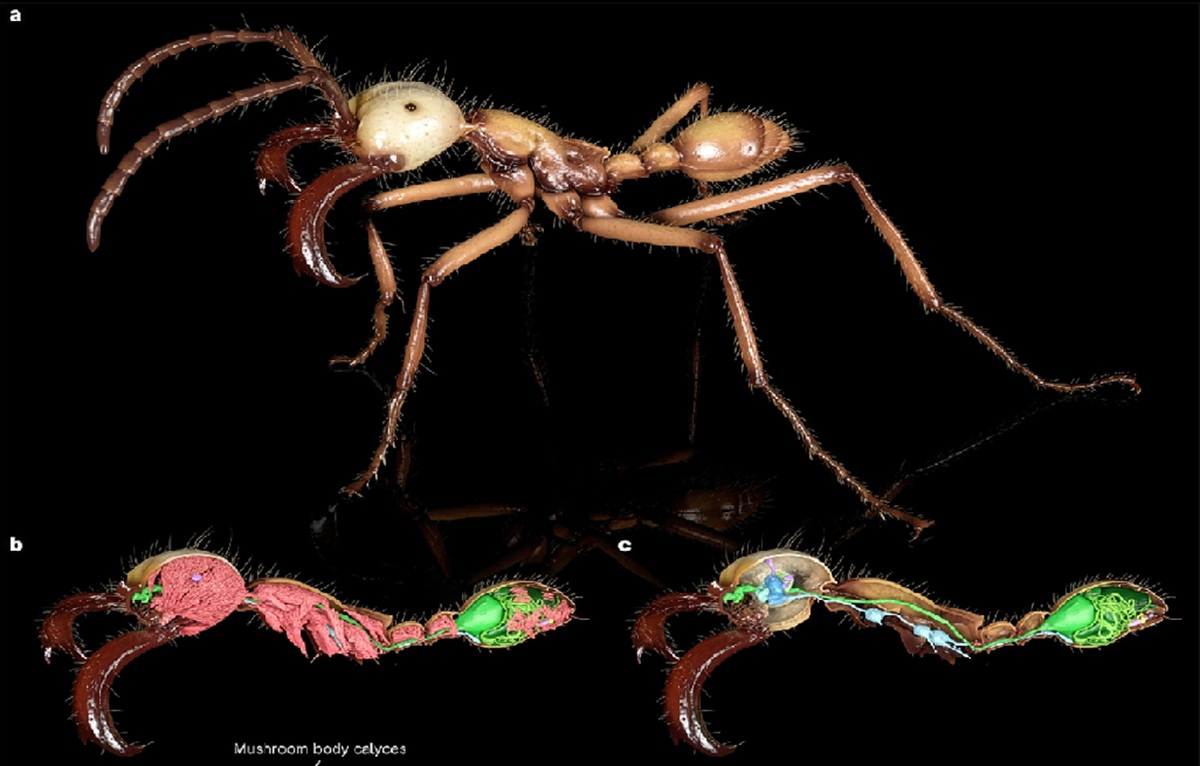
Ants are among the most successful animals on Earth, yet studying their internal anatomy on a large scale has posed an extraordinary challenge for scientists. This obstacle has now been overcome through an ambitious project that has produced the most extensive three-dimensional (3D) anatomical record ever created.
Researchers have scanned nearly 2,200 specimens representing approximately 800 ant species. The project has converted museum collection insects into detailed digital bodies that can be explored layer by layer, from muscle structures, nervous systems, digestive organs, to stinging apparatus.
The key to the project’s speed was the use of a German synchrotron beamline, a particle accelerator that generates extremely powerful X-rays. With the assistance of a robot that replaced samples every 30 seconds, the team was able to perform 25 scans per hour.
By comparison, conventional laboratory scanners would require more than six years of continuous work to achieve the same coverage. In just one week, this technology successfully processed approximately 2,000 specimens.
The collection, named Antscan, encompasses 212 genera, representing more than 90% of identified ant species worldwide. The archive includes not only worker ants but also queens and male ants to provide a complete picture of evolutionary development.
The method used is micro-CT, which allows researchers to visualise soft tissue alongside the hard exoskeleton of ants without having to dissect or damage precious museum specimens. During the scanning process, ants remain preserved in ethanol solution.
However, challenges emerged after scanning. Many specimens stored in bottles were found in unnatural, curled positions. To address this, software engineering students at the University of Maryland (UMD) began developing an artificial intelligence-powered tool for pose estimation to restore digital ant postures to natural positions.
Data from Antscan has already begun providing new insights. One subsequent study examined the cuticle (hard outer layer) on 507 species. The findings revealed an intriguing pattern: colonies tend to grow larger when individual workers possess thinner “armour”.
This analysis suggests that collective strength often increases when the energy cost of producing each individual becomes cheaper due to reduced protective material.
The good news is that the Antscan archive is not restricted to specialist laboratories. The data is available for free download and is equipped with an integrated viewer function. This allows anyone to explore ant anatomy without needing their own scanning equipment.
Although currently facing data storage capacity constraints of 200 terabytes, this project, published in the journal Nature Methods, has established a new standard in biological digitalisation. In future, this approach is expected to be applied to other small organisms to reveal the secrets of life on Earth more profoundly.